
Table of Contents
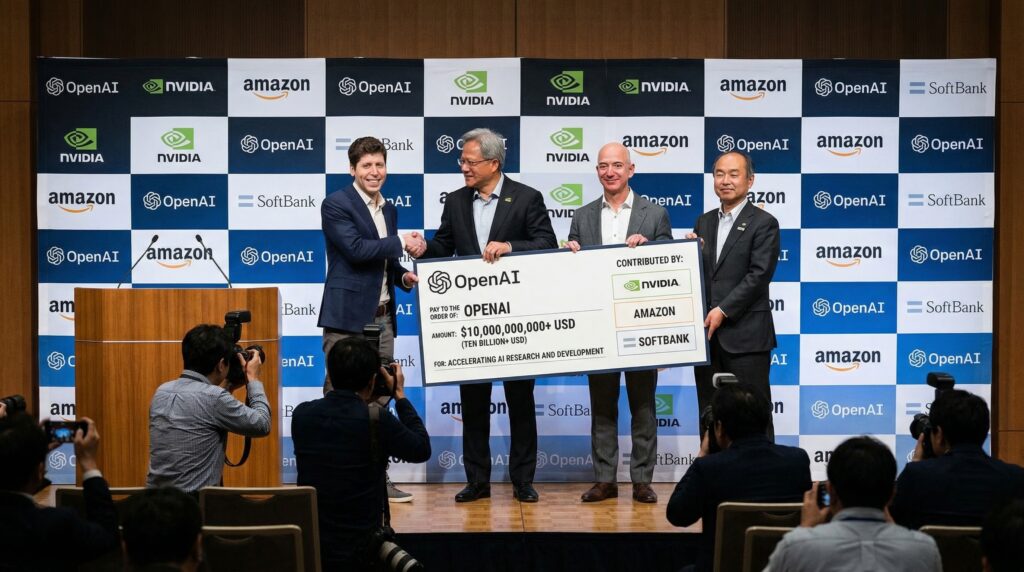
In a world already electrified by the rapid rise of artificial intelligence, OpenAI just turned up the voltage to an almost incomprehensible level. On February 27, 2026, the San Francisco-based AI powerhouse announced a jaw-dropping $110 billion funding round — the largest private financing in the history of technology. Backed by three of the most influential names in the industry — Amazon, Nvidia, and SoftBank — this deal doesn’t just set a new record; it signals a seismic shift in who controls the future of AI, and at what scale.
A Number That Defies Imagination
Let’s put $110 billion into perspective. In 2023, venture capitalists invested a total of $170 billion across all U.S. startups combined. OpenAI just raised nearly two-thirds of that amount in a single round. The figure more than doubles OpenAI’s previous fundraise — itself a record at the time — and propels the company to a pre-money valuation of $730 billion, or $840 billion when including the new capital.
This isn’t just a funding round. It’s a declaration of war on the future — a bet by three tech titans that OpenAI will sit at the center of civilization’s most transformative technological era.
The Power Trio Behind the Money
The round is anchored by three heavyweight investors, each with distinct motivations:
Amazon leads with a staggering $50 billion commitment, the largest slice of the pie. But money alone doesn’t capture the full scope of this deal. Amazon CEO Andy Jassy framed it plainly: “It’s so early right now in the AI space, and OpenAI is off to an amazing start.” Beyond the investment, the two companies struck a sweeping infrastructure pact. OpenAI will expand its existing $38 billion AWS agreement by an additional $100 billion over the next eight years. AWS will become the exclusive third-party cloud distribution provider for OpenAI’s enterprise platform, Frontier. OpenAI has also committed to consuming at least 2 gigawatts of Amazon’s in-house Trainium AI chips — a massive vote of confidence in Amazon’s custom silicon ambitions.
Nvidia comes in at $30 billion, a figure that put months of speculation to rest. Nvidia CEO Jensen Huang had publicly dismissed rumors of a scaled-back commitment just weeks earlier, insisting, “We will invest a great deal of money. I believe in OpenAI.” As part of the expanded collaboration, OpenAI secured access to 3 gigawatts of dedicated inference capacity and 2 gigawatts of training capability on Nvidia’s next-generation Vera Rubin GPU architecture. In a world where compute is the new oil, this partnership ensures OpenAI has some of the richest reserves on the planet.
SoftBank rounds out the trio with its own $30 billion stake, continuing the Japanese conglomerate’s deep strategic bet on OpenAI. SoftBank’s Masayoshi Son has long positioned himself as a visionary of the AI age, and this investment cements that thesis.
What It Means for OpenAI’s Future
The implications of this funding are enormous and multi-layered.
Infrastructure at civilizational scale. AI doesn’t run on ideas alone — it runs on GPUs, data centers, and power grids. Training frontier models like GPT-5 and beyond requires electricity measured in gigawatts, hardware measured in the hundreds of thousands of chips, and capital expenditure that dwarfs almost any other industry. This funding gives OpenAI the financial runway to build infrastructure that can serve not just millions — but billions — of users.
Products reaching critical mass. The numbers speak for themselves: ChatGPT now boasts over 900 million weekly active users and more than 50 million consumer subscribers. OpenAI’s coding tool, Codex, has seen its weekly user base more than triple since the start of 2026, reaching 1.6 million developers. Over 9 million paying business users rely on ChatGPT for work. The company is no longer a research lab with a product — it is a platform on which an ecosystem is being built.
The road to IPO. This funding round arrives amid growing anticipation of OpenAI’s public debut. Reuters reported that the deal comes ahead of the company’s expected mega-IPO, potentially one of the most significant market listings in history. Interestingly, $35 billion of Amazon’s investment is reportedly contingent on OpenAI either achieving AGI (Artificial General Intelligence) or completing its IPO by year-end — a clause that adds both urgency and drama to the story.
Antitrust eyes watching. Not everyone is cheering. Federal regulators are almost certain to scrutinize the web of partnerships being woven here. The FTC has previously examined the relationship between OpenAI and Microsoft. Now, with Amazon making a $50 billion play while also serving as a cloud provider, and Nvidia simultaneously supplying chips and equity, questions around vertical integration and competitive fairness are inevitable.
What About Microsoft?
Lost in the excitement is an important footnote: Microsoft did not participate in this round. The Redmond giant has been OpenAI’s anchor investor since 2019, pouring in tens of billions and integrating OpenAI’s models across its product suite. OpenAI was quick to reassure markets, issuing a joint statement clarifying that “nothing about this announcement changes the terms” of its existing Microsoft partnership. Azure remains the exclusive cloud provider for OpenAI’s APIs, and Microsoft retains its exclusive license and access to OpenAI’s intellectual property. Still, the emergence of Amazon as a co-equal infrastructure partner represents a meaningful diversification — and a quiet power shift in Silicon Valley’s most important alliance.
The Bigger Picture
OpenAI CEO Sam Altman has described this moment with characteristic ambition: “We are entering a new phase where frontier AI moves from research into daily use at global scale. Leadership will be defined by who can scale infrastructure fast enough to meet demand.”
That philosophy — scale first, everything else follows — is exactly what this $110 billion is designed to enable. Whether you view it as visionary or reckless, the magnitude of capital flowing into OpenAI reflects a near-universal conviction among the world’s largest technology companies: the AI race is not slowing down. It is just beginning.