
In the rapidly evolving landscape of digital marketing, AI tools have transitioned from novel curiosities to essential components of the content creation workflow. Two of the most prominent platforms leading this charge are OpenAI’s ChatGPT and Google’s Gemini. For marketers seeking efficiency, scale, and quality, the decision between ChatGPT vs. Google Gemini for content marketing is a critical one. This article provides a detailed, strategic comparison to help you determine which tool—or combination—best aligns with your content marketing objectives.
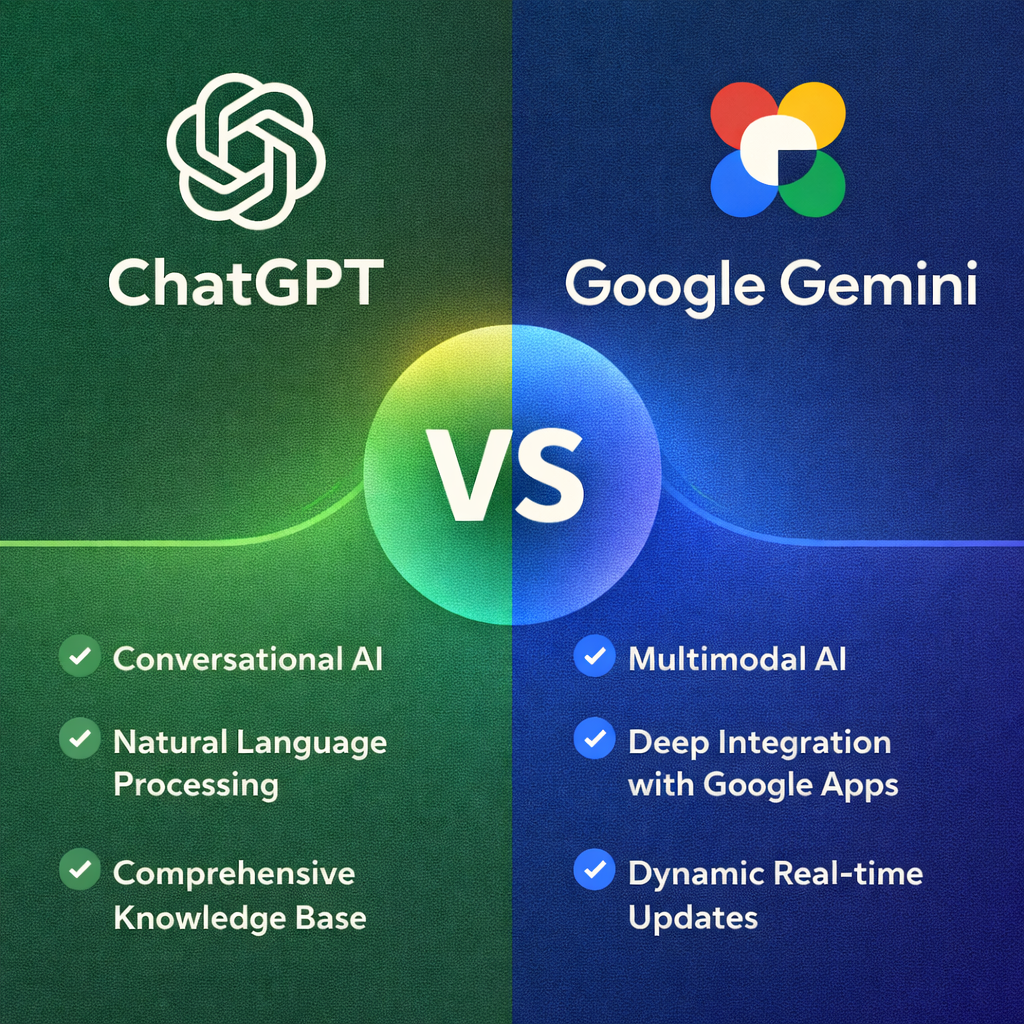
Table of Contents
Understanding the Core Technologies
Before diving into the direct matchup of ChatGPT vs. Google Gemini for content marketing, it’s important to understand their foundational differences.
ChatGPT, powered by OpenAI’s GPT architecture, is a generative AI model trained on a vast and diverse dataset. Its strengths lie in creative text generation, conversational nuance, and long-form content structuring. It has become synonymous with AI-assisted writing.
Google Gemini (formerly Bard) is built on Google’s Pathways Language Model (PaLM) and is deeply integrated with the Google ecosystem, including Search, YouTube, and Google Workspace. Its design emphasizes real-time information retrieval and direct access to current web data.
The fundamental distinction sets the stage for our exploration of ChatGPT vs. Google Gemini for content marketing use cases.
Strengths of ChatGPT vs. Google Gemini for Content Marketing: A Side-by-Side Analysis
1. Ideation and Brainstorming
Both tools excel at overcoming creative block, but with different flavors.
- ChatGPT is exceptional at generating expansive lists of blog topics, headline variations, and creative campaign angles based on its trained knowledge. You can ask it to brainstorm in the style of specific industries or tones.
- Gemini’s integration with Google Trends and real-time search data allows it to suggest topics with proven, current search volume and rising trends. This makes the analysis of ChatGPT vs. Google Gemini for content marketing ideation a choice between creative breadth and data-driven relevance.
Verdict: Gemini may have a slight edge for SEO-focused ideation, while ChatGPT shines for purely creative, out-of-the-box concepts.
2. Drafting and Long-Form Content Creation
This is a core battleground in the ChatGPT vs. Google Gemini for content marketing debate.
- ChatGPT (particularly GPT-4) is often praised for its ability to maintain coherent narrative flow over long passages. Its ability to follow complex style guides and adapt to a specified tone of voice is highly refined. Many users find its output requires less structural editing for long-form articles and whitepapers.
- Gemini creates competent drafts and can seamlessly pull in recent facts, statistics, or news events. However, some users note its outputs can sometimes require more editing for fluidity and brand voice consistency in extended formats.
Verdict: For the first draft of a long-form blog or report, ChatGPT frequently takes the lead in coherence and adherence to stylistic instruction.
3. SEO and Content Optimization
Modern content marketing is inseparable from SEO, a key area in the ChatGPT vs. Google Gemini for content marketing discussion.
- ChatGPT requires explicit prompts and plugins (like the Browse feature) to access current web data. It can generate meta descriptions, title tags, and keyword-rich content structures based on your provided keyword research. Its strength is in on-page optimization execution.
- Gemini has a native, formidable advantage. It can directly analyze current search engine results, suggest semantically related keywords, and answer questions like “what are people also asking about this topic?” by querying live Google Search data. This makes it a powerful tool for initial SEO research and strategy.
Verdict: For integrated SEO research and content planning, Gemini is unmatched. For implementing optimization into written content, both are capable.
4. Fact-Checking and Accuracy
Accuracy is non-negotiable in content marketing.
- ChatGPT’s knowledge is bound by its training data cutoff date, and it is prone to “hallucinating” facts or sources. Any statistical or current claim it makes must be rigorously verified by the human marketer.
- Gemini, by design, has more current information and often cites its sources, allowing for easier fact-checking. Its connection to Google’s knowledge graph provides a higher degree of factual reliability for recent events and data.
Verdict: In the ChatGPT vs. Google Gemini for content marketing accuracy test, Gemini offers greater inherent verifiability and timeliness.
Key Considerations for Your Marketing Stack
Choosing between ChatGPT vs. Google Gemini for content marketing isn’t necessarily an either/or proposition. Consider these factors:
- Integration Needs: Do you heavily use Google Workspace (Docs, Sheets)? Gemini’s integration is seamless. Does your workflow rely on other platforms via APIs? ChatGPT has a robust and established ecosystem of integrations.
- Budget: Both offer free tiers with limitations. ChatGPT Plus is a paid subscription, while Gemini Advanced is part of the Google One AI Premium plan. Compare feature sets against cost.
- The Human-in-the-Loop: Regardless of your choice in the ChatGPT vs. Google Gemini for content marketing decision, neither tool is a set-and-forget solution. The most effective strategy uses AI for drafting, ideation, and scaling, while relying on human marketers for strategy, fact-checking, brand voice finalization, and adding unique expertise and experience—the very elements Google’s E-E-A-T guidelines reward.
The Hybrid Approach: A Strategic Recommendation
For many content marketing teams, the most powerful strategy is a hybrid workflow that leverages the unique strengths of both tools in the ChatGPT vs. Google Gemini for content marketing landscape. Consider this pipeline:
- Trend & Keyword Research with Gemini: Use Gemini to identify trending topics, analyze competitor angles, and gather current data and FAQs.
- Outline and Draft with ChatGPT: Feed the research into ChatGPT to generate a structured outline and a coherent, stylistically consistent first draft.
- Fact-Check and Update with Gemini: Run the draft back through Gemini to verify facts, update statistics, and ensure topical relevance.
- Human Editing and Branding: The marketer adds final edits, unique insights, case studies, and the authentic brand voice that AI cannot replicate.
This approach strategically navigates the ChatGPT vs. Google Gemini for content marketing dilemma by using each tool for its superpower.
Conclusion
The debate between ChatGPT vs. Google Gemini for content marketing reveals that both are exceptionally capable, yet distinct, tools. ChatGPT vs. Google Gemini for content marketing ultimately boils down to your primary need: if superior narrative flow and creative drafting are paramount, ChatGPT is a formidable choice. If real-time data, integrated SEO research, and factual accuracy for timely content are your drivers, Gemini holds a significant advantage.
The astute content marketer will not see ChatGPT vs. Google Gemini for content marketing as a binary choice but as an opportunity to build a more resilient and capable content engine. By understanding the nuanced strengths in the ChatGPT vs. Google Gemini for content marketing comparison, you can integrate these AI assistants to enhance human creativity, not replace it, driving greater efficiency and impact in your content strategy.