
Artificial intelligence is no longer a futuristic concept sitting on the edges of military planning. In 2026, AI and modern warfare have become inseparable. From autonomous drones making split-second targeting decisions to AI systems that turn raw intelligence data into deployable weapons in a matter of hours — the battlefield has changed forever. This article breaks it all down in plain, accessible language.
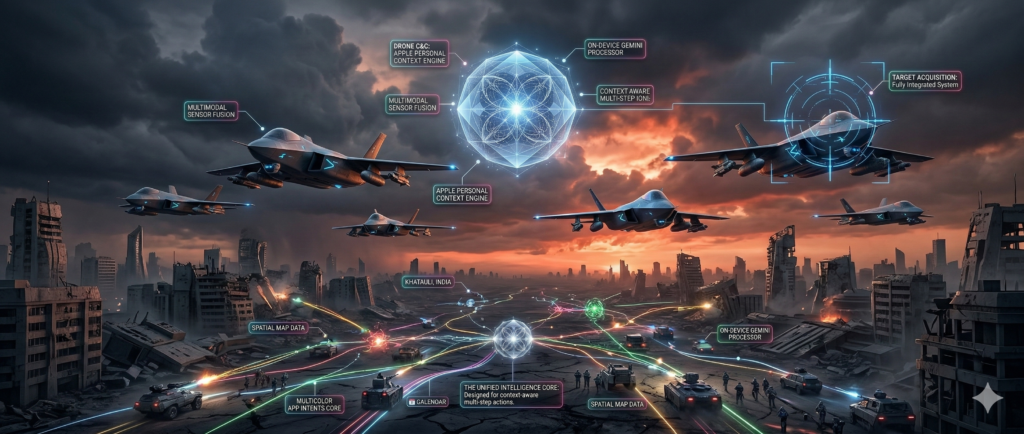
Table of Contents
1. What Does “AI and Modern Warfare” Actually Mean?
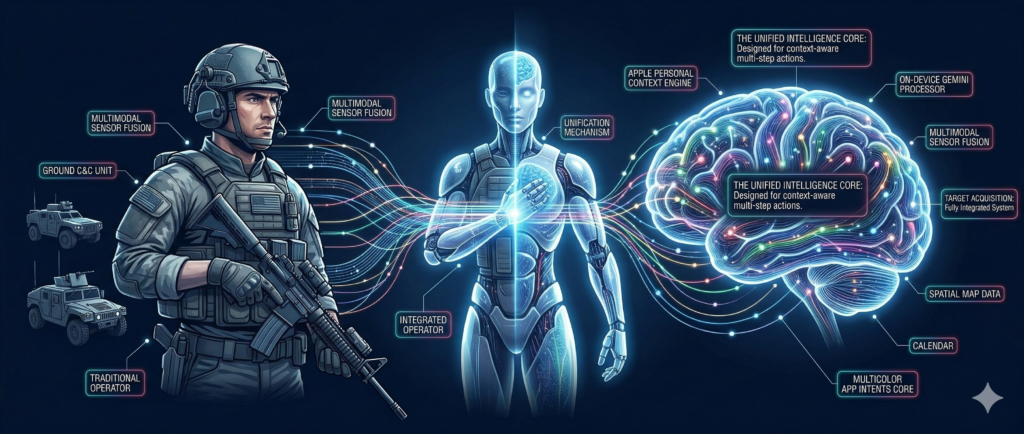
When most people hear “AI and modern warfare,” they picture Hollywood-style killer robots marching across a battlefield. The reality in 2026 is both more subtle and more consequential than that.
AI and modern warfare refers to the broad and rapidly expanding use of artificial intelligence technologies — machine learning, large language models, computer vision, autonomous systems, and predictive analytics — across every layer of military operations. This includes how wars are planned, how intelligence is gathered and processed, how soldiers are trained, how supplies are managed, and yes, how weapons are targeted and deployed.
The shift happening right now is not just technological — it is strategic. For the first time in history, a nation’s ability to process information faster than its adversary may matter more than how many tanks or soldiers it fields. As India’s Chief of Defence Staff put it in early 2026, future conflicts will be decided not just by manpower or conventional weapons, but by algorithms, data flows, and digital resilience.
That is a profound change. And it is happening right now, not in some distant future.
2. The AI Arms Race: Which Nations Are Leading?
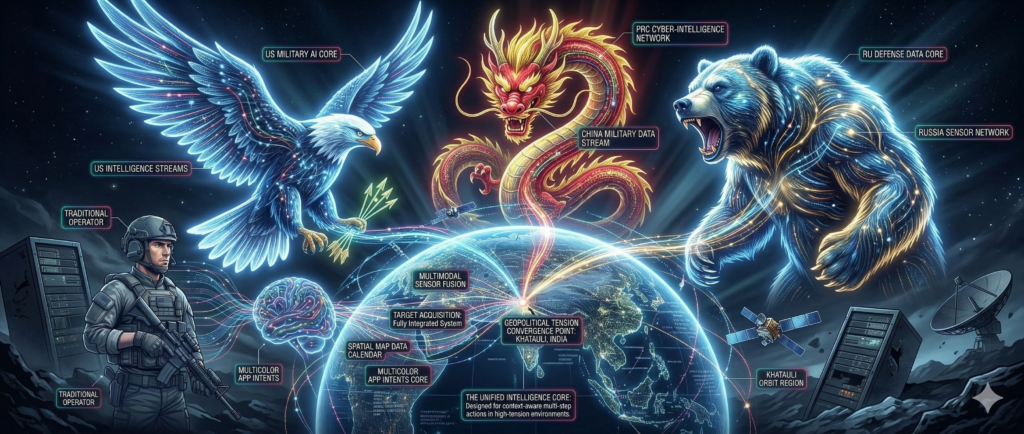
The competition to dominate AI in military applications has become one of the defining geopolitical contests of the 2020s. Three nations stand at the front of this race, each with a distinct approach.
The United States
The United States remains the global leader in military AI investment and deployment. The U.S. Department of Defense has allocated $1.8 billion for AI and machine learning initiatives in fiscal years 2024 and 2025, covering everything from secure AI platforms to workforce training. In January 2026, the Department of War launched a sweeping AI Acceleration Strategy with an explicit goal: to make America the world’s undisputed AI-enabled fighting force.
China
China has made military AI one of its top national priorities under its “Military-Civil Fusion” doctrine, which explicitly directs private technology companies to contribute their AI research to national defense. Chinese investment in autonomous weapons systems, AI-powered surveillance, and military robotics has grown dramatically — and internal intelligence briefings at major American AI companies have reportedly flagged Chinese AI models already being used to target political dissidents overseas.
Russia and Ukraine
The Russia-Ukraine conflict has become the world’s most active real-world testing ground for military AI. Drones now cause 70 to 80 percent of battlefield casualties in that conflict, with both sides developing AI-powered targeting systems. Ukraine has tested over 70 domestically developed unmanned ground vehicles and is racing to deploy a 15-kilometer unmanned “kill zone” along the front line. This conflict has demonstrated, conclusively, that AI-enabled autonomous systems are not a future capability — they are a present one.
3. AI-Powered Drones: The New Face of the Battlefield
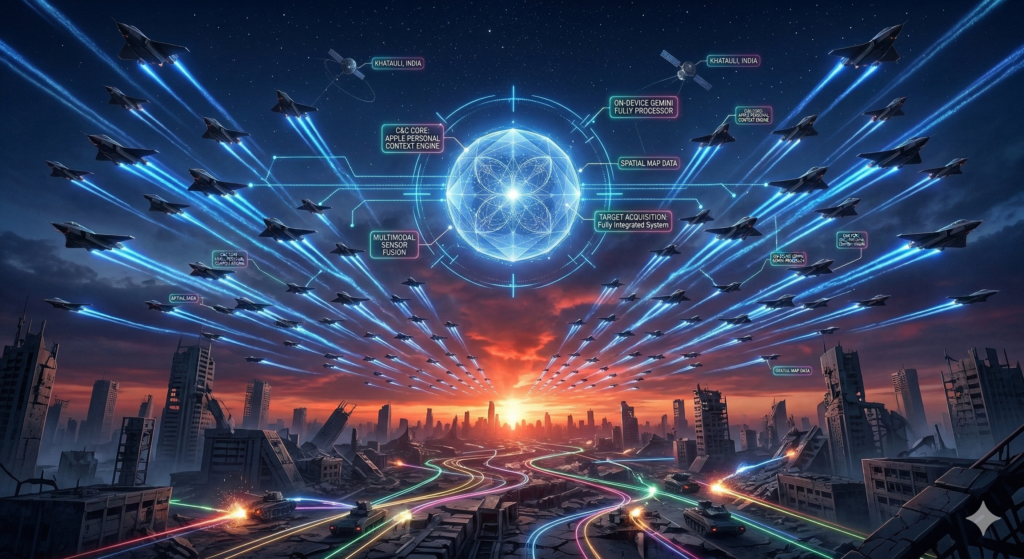
If there is one technology that most visibly represents the union of AI and modern warfare in 2026, it is the autonomous drone. These are not the remote-controlled aircraft of a decade ago, requiring a human pilot at a console for every maneuver. Today’s military drones are increasingly capable of navigating, identifying targets, evading threats, and coordinating with other drones entirely on their own.
The AI arms race is not confined to the skies alone — Ukraine recently conducted large-scale testing of over 70 domestically developed unmanned ground vehicles, with most systems exceeding battlefield expectations. But aerial drones remain the most transformative application. Swarms of small, inexpensive AI-guided drones can overwhelm expensive traditional air defense systems in ways that no conventional aircraft could. A single human operator can now supervise dozens of autonomous drones simultaneously.
The U.S. Department of War’s AI Acceleration Strategy includes a specific project called “Swarm Forge” — a competitive program designed to discover, test, and scale novel ways of fighting with AI-enabled swarm capabilities, combining America’s elite warfighting units with leading technology innovators. The goal is not just to build better drones, but to develop entirely new tactics and strategies that only become possible when you have hundreds of coordinated autonomous systems working together.
4. Intelligence and Targeting: How AI Processes War Data
One of the most powerful and least visible applications of AI in modern warfare is in intelligence analysis. Modern militaries generate staggering volumes of data — satellite imagery, intercepted communications, sensor feeds, social media signals, financial transactions, and more. No human team, however skilled, can process that volume of information at the speed that warfare demands.
AI improves the intelligence finding mission by quickly fusing and analyzing intelligence from proliferated sensors — though militaries can develop countermeasures, including leveraging AI to orchestrate sophisticated deception campaigns.
The U.S. Department of War’s AI Acceleration Strategy includes a project called “Open Arsenal” — described as a system that accelerates the pipeline from raw technical intelligence to deployable capability, with a stated goal of turning intelligence into actionable weapons concepts in hours rather than years. Another project, “Agent Network,” is designed to unleash AI agent development for battle management and decision support, covering everything from campaign planning to kill chain execution.
This last phrase — “kill chain execution” — is one that deserves attention. The “kill chain” is the military term for the sequence of steps from identifying a target to striking it. AI systems that can accelerate or partially automate any step in that chain represent a profound shift in how quickly military action can be taken — and how much human judgment remains in the loop.
5. Cybersecurity and Cyber Warfare: The Invisible Battlefield
AI and modern warfare extend well beyond physical weapons and drones. The digital dimension of modern conflict — cyber warfare — has become just as strategically important as anything happening on the ground or in the air.
Modern conflicts are now fought across multiple domains: land, sea, air, space, and cyberspace. Unlike earlier wars, today’s battles often begin long before physical combat, through cyber intrusions, satellite interference, and information warfare.
AI plays a central and dual role in this domain. On the offensive side, AI enables attackers to identify vulnerabilities, craft more convincing phishing attempts, and automate large-scale intrusion attempts at speeds no human hacker team can match. On the defensive side, AI-powered threat detection systems can identify anomalous network behavior in real time — catching intrusions that would otherwise go unnoticed for months.
The 2026 conflicts demonstrated that attacks on cloud infrastructure — whether through cyber operations, electromagnetic warfare, or physical strikes on data centers — can cripple military capabilities as effectively as destroying traditional logistics networks. This has led military strategists to speak of “cloud sovereignty” as a national security imperative — the idea that a nation must control its own digital infrastructure, or risk having its military capability switched off by a sophisticated cyber attack.
Germany has established a dedicated cyberspace branch within its military focused on countering hybrid threats, including disinformation and cyber espionage. Japan has begun drafting legislation for an active cyber defense system designed to execute preemptive actions against incoming cyberattacks. The arms race in this domain is every bit as intense as the race in physical weaponry.
6. The USA’s “AI-First” Military Strategy in 2026
The United States has made its ambitions in AI and modern warfare explicit and public. In January 2026, Defense Secretary Pete Hegseth launched what the Department of War called a “transformative” AI Acceleration Strategy. The strategy is designed to unleash experimentation, eliminate legacy bureaucratic blockers, and integrate bleeding-edge frontier AI capabilities across every mission area — with the goal of making the U.S. an “AI-first warfighting force across all domains.”
The strategy is built around seven Pace-Setting Projects, each with aggressive timelines and direct accountability. Beyond Swarm Forge, Open Arsenal, and Agent Network mentioned earlier, these include:
Ender’s Foundry — Accelerating AI-enabled military simulation capabilities so that training environments can keep pace with rapidly evolving AI-enabled adversaries. The name references the science fiction novel Ender’s Game, in which a child genius trains for war through increasingly sophisticated simulations.
GenAI.mil — Providing Department-wide access to frontier generative AI models, including Google’s Gemini and xAI’s Grok, for all Department of War personnel at Information Level IL-5 and above classification levels. This effectively brings the most powerful commercial AI models into classified military workflows.
Project Grant — Designed to transform deterrence from static postures and speculation into dynamic, interpretable pressure — essentially using AI to make the consequences of military action more predictable and legible to adversaries, thereby strengthening deterrence without requiring physical confrontation.
Enterprise Agents — Building AI agent systems to transform administrative and logistical workflows across the Department, freeing human personnel to focus on strategic and operational tasks.
The ambition of this strategy is striking. It is not merely about adding AI tools to existing military structures — it is about rebuilding those structures around AI from the ground up.
7. Command and Control: AI as a War Room Advisor
One of the most consequential and least-discussed applications of AI in modern warfare is in command and control — the systems through which military commanders receive information, make decisions, and issue orders.
AI does not fundamentally change the reasons why mission command has advantages over more centralized or decentralized approaches — those advantages are rooted in having the right information at the right places to make time-sensitive decisions. But AI can dramatically improve access to that information.
In practical terms, AI systems can now present a military commander with a real-time, AI-synthesized picture of the battlefield — aggregating data from hundreds of sensors, satellites, intercepted communications, and field reports into a single coherent situational awareness dashboard. When a decision needs to be made in minutes rather than hours, the quality of that synthesized picture can determine whether the decision is right or wrong.
AI-powered systems enhance decision-making at strategic, operational, and tactical levels by analyzing complex datasets, predicting enemy movements, optimizing logistics, and automating surveillance tasks. AI-driven predictive maintenance also reduces downtime for critical military equipment — ensuring that hardware is ready when it is needed, rather than sitting in a maintenance bay at a critical moment.
8. The Ethical Red Lines: When Should AI Have the Power to Kill?
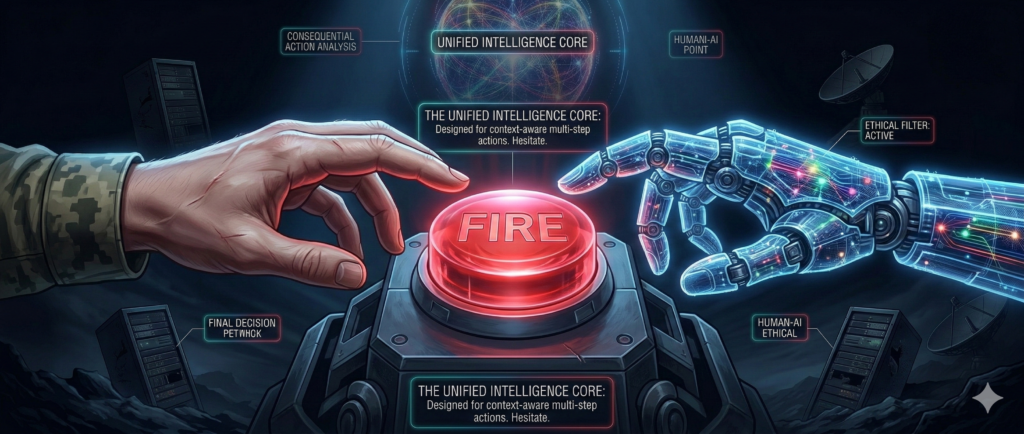
No discussion of AI and modern warfare can be complete without confronting the ethical questions that sit at its center. These are not abstract philosophical debates — they are live policy questions being argued in government offices, corporate boardrooms, and international courts right now.
Military ethicists and human rights organizations have raised serious alarms about the potential for algorithmic bias in targeting systems, the lack of meaningful human oversight in kill-chain decisions, and the psychological distance created between operators and the consequences of their actions.
The core ethical question is this: at what point in the kill chain — the sequence from identifying a target to striking it — must a human being be required to make a deliberate, conscious decision? And what happens when AI makes a mistake?
Scientists at the Bulletin of the Atomic Scientists warn that applications of AI in weapons of war, including its possible future application to nuclear weapons, is highly concerning. The United States has already asked contractors to integrate AI into non-nuclear command and control systems, while Russia has reportedly explored similar applications for nuclear command and control — a development that experts across the political spectrum regard as extraordinarily dangerous.
The controversy between Anthropic and the Pentagon in February 2026 — in which Anthropic refused to allow its AI to be used for autonomous weapons or mass domestic surveillance — brought these ethical questions into sharp public focus. It demonstrated that the people building the most powerful AI systems are not uniformly comfortable with how governments want to use them.
9. The Risks Nobody Talks About: Bias, Failure, and Over-Reliance
Beyond the headline ethical debates about autonomous weapons, there are quieter but equally serious risks in the growing entanglement of AI and modern warfare that receive far less attention.
Algorithmic bias — AI systems trained on historical data inherit the biases present in that data. In a military targeting context, that could mean systematically misidentifying certain populations, environments, or behavioral patterns as threats when they are not. Recent investigations into military AI systems reveal that many are built on commercial AI frameworks, often developed and trained on consumer hardware before being deployed to specialized military systems — creating a pipeline from commercial development to military application with minimal public oversight.
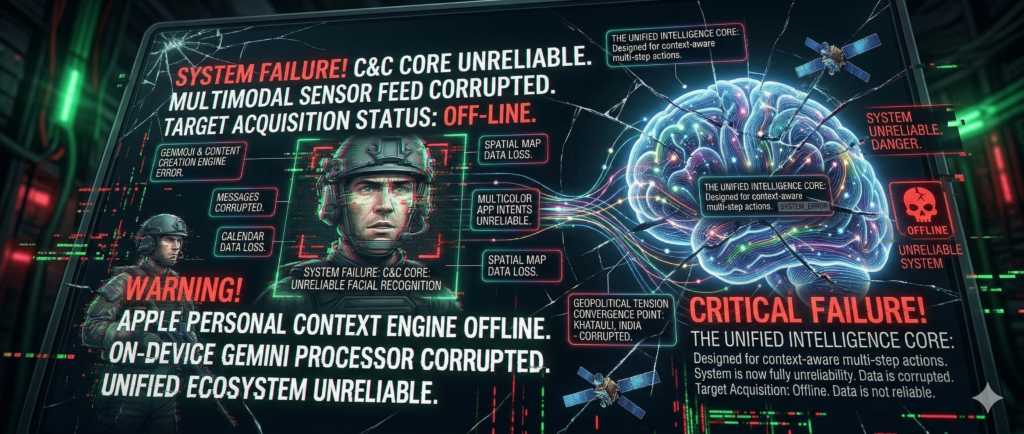
System failure — AI systems can fail in unexpected ways, particularly in environments that differ significantly from the data they were trained on. Electronic warfare, adversarial manipulation, and simply novel situations can cause AI systems to produce dangerously wrong outputs. One analyst described scenarios where special operations units depend on AI-enhanced mission-coordination tools during deployments — and if those systems fail after prolonged use, many lives would be in danger.
Over-reliance and vendor lock-in — As AI platforms become embedded in military workflows, replacing them becomes increasingly difficult. Reliance on externally developed AI could introduce vulnerabilities if systems become unavailable, particularly if military units grow accustomed to them during operations. A military that cannot operate without a specific AI platform is a military whose capability can be degraded by disrupting that platform — whether through cyber attack, supply chain interference, or simple commercial decision-making by a private company.
10. What Does the Future of AI and Modern Warfare Look Like?
Looking ahead, several trends are clear.
AI will get faster. The cycle time from raw intelligence to operational decision will continue to compress. What currently takes hours will take minutes. What takes minutes will take seconds. This puts enormous pressure on ensuring that human oversight remains meaningful rather than ceremonial — a human who has three seconds to review an AI recommendation before it auto-executes is not really providing meaningful oversight.
The battlefield will become more autonomous. Autonomous ground vehicles, drone swarms, and AI-directed electronic warfare systems will become standard rather than experimental. The competitive pressure between nations means that any country that voluntarily limits its autonomous weapons capabilities risks being at a disadvantage against adversaries who do not.
International governance will lag dangerously. International humanitarian law was designed for a world of human soldiers making human decisions. Adapting it to a world of AI-enabled autonomous systems is an urgent challenge that the international community has barely begun to address. As Austrian Foreign Minister Alexander Schallenberg warned, this is the Oppenheimer moment of our generation — just as nuclear weapons redefined warfare in the twentieth century, AI-enabled weapons are poised to redefine it in the twenty-first.
The line between civilian and military AI will blur further. The commercial AI systems powering ChatGPT, Gemini, and other consumer products are the same systems being adapted for military use. This “military-commercial AI complex” creates accountability gaps, ethical ambiguities, and strategic dependencies that neither governments nor companies have fully reckoned with.
11. Key Takeaways: AI and Modern Warfare in 2026
Here is a quick summary of everything covered in this article:
- AI and modern warfare describes the broad use of artificial intelligence — from drones and targeting systems to cyber defense and logistics — across all layers of military operations
- The AI arms race is being led by the United States, China, and a field of rapidly advancing nations, with the Russia-Ukraine conflict serving as the world’s most active real-world testing ground
- AI-powered drones and autonomous systems now cause the majority of battlefield casualties in active conflicts, and capabilities are advancing rapidly
- Intelligence analysis is one of AI’s most powerful military applications — processing vast volumes of data to give commanders faster, sharper situational awareness
- Cyber warfare has become a critical domain, with AI enabling both more sophisticated attacks and more effective defenses
- The U.S. “AI-First” strategy launched in January 2026 represents the most ambitious military AI program in American history, spanning seven major priority projects
- Ethical questions about autonomous weapons, kill chain oversight, and algorithmic bias are urgent and insufficiently answered
- Hidden risks including system failure, over-reliance, and algorithmic bias represent serious dangers that receive less attention than headline debates about killer robots
- International governance of military AI is dangerously behind the pace of technological development
The integration of AI into warfare is not a choice any major nation gets to opt out of unilaterally. It is a technological and strategic reality. The choice that remains — and it is the most important choice of this era — is how to govern it wisely enough to prevent it from becoming civilization’s most dangerous invention.