
The AI & defense controversy of 2026 exploded into public view when Anthropic was blacklisted by the Pentagon, OpenAI struck a rushed deal hours later, and over 220 employees signed a petition that shook the entire tech industry. Here’s everything you need to know.
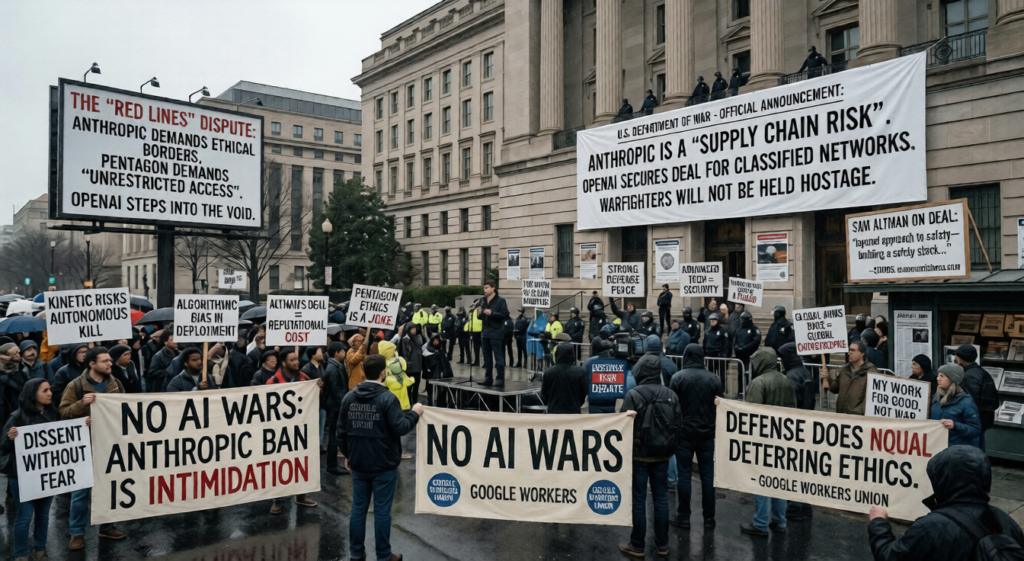
Table of Contents
In late February 2026, a slow-burning dispute between the United States military and the artificial intelligence industry erupted into one of the most consequential technology policy showdowns in American history — and the ripple effects are still being felt.
What Is the AI & Defense Controversy?
The AI & defense controversy refers to the explosive standoff between the U.S. Department of Defense (Pentagon) and several leading artificial intelligence companies — most critically Anthropic, OpenAI, and Google — over the terms under which military forces can use AI technology. At its core, this controversy is about two deeply uncomfortable questions: Should AI be used to spy on American citizens? And should AI be allowed to make life-or-death decisions in war without human approval?
The AI & defense controversy has been simmering since the Trump administration took office in 2025 and began framing AI development as a wartime strategic priority. Defense Secretary Pete Hegseth publicly described the AI landscape as an “arms race” and pushed for full, unrestricted access to the most advanced commercial AI models available. When Anthropic refused those terms, the confrontation became unavoidable.
📋 AI & Defense Controversy — Key Facts at a Glance
| Core Dispute | Pentagon demanded unrestricted AI access for all “lawful” military use; Anthropic refused on safety grounds |
| Anthropic’s Red Lines | No mass domestic surveillance of U.S. citizens; no fully autonomous lethal weapons |
| Government Action | Trump blacklisted Anthropic; Hegseth designated it a national “Supply-Chain Risk” — first-ever use against a U.S. company |
| Contract Value | Up to $200 million — Anthropic had been the only commercial AI firm cleared for classified Pentagon systems |
| OpenAI Response | Signed Pentagon deal within hours, with similar stated safeguards — Sam Altman called it “definitely rushed” |
| Employee Protest | 220+ Google & OpenAI employees signed the “We Will Not Be Divided” petition |
| Anthropic Legal Plan | Filed to challenge “supply-chain risk” designation in federal court |
How Did the AI & Defense Controversy Begin?
Anthropic had, until late February 2026, been the only large commercial AI company whose models were approved for classified use inside Pentagon systems. This deployment was facilitated through a partnership with defense data firm Palantir. But as that contract came up for renegotiation, the Pentagon pushed for something far broader: the right to use Anthropic’s Claude AI for every “lawful purpose” the military could conceive of — with no carved-out exceptions.
Why Anthropic Said No
Anthropic’s position was methodical and principled. The company argued that existing U.S. law has simply not caught up with the capabilities of modern AI. While traditional law might technically permit certain types of mass data collection, Anthropic was concerned that advanced AI could dramatically supercharge that collection — turning legal-but-limited surveillance into something qualitatively different and far more dangerous.
Their two non-negotiable restrictions were:
Context Anthropic was founded in 2021 by former OpenAI researchers — including Dario Amodei — who left specifically over concerns about AI safety. This origins story makes its stance in the AI & defense controversy particularly resonant.
1. No mass domestic surveillance of Americans. Anthropic argued this violates Fourth Amendment rights and chills free expression. AI-enabled surveillance could allow authorities to track citizens at unprecedented scale using publicly available data like social media posts and geolocation signals — activities currently legal in narrow contexts but not contemplated at AI scale.
2. No fully autonomous lethal weapons. Anthropic stated clearly that today’s frontier AI models are simply not reliable enough to make life-or-death decisions independently. Deploying them in that role, the company said, would endanger both American warfighters and civilians.
“Disagreeing with the government is the most American thing in the world. And we are patriots. In everything we have done here, we have stood up for the values of this country.”
— Dario Amodei, CEO, Anthropic
The Government’s Nuclear Response
When Anthropic held its position, the Trump administration did not engage in further negotiation. It escalated dramatically. On February 27, 2026, President Trump posted on Truth Social ordering every federal agency in the United States to immediately cease all use of Anthropic’s technology. Defense Secretary Hegseth formally designated Anthropic a “Supply-Chain Risk to National Security.”
That designation, legal experts immediately noted, had never before been applied to an American company. It is a label typically reserved for foreign adversaries or organizations with ties to hostile states. Its use against a domestic AI startup — as apparent retaliation for refusing to waive safety restrictions — was described by policy analysts as unprecedented and legally dubious.
⚠️Legal Implications: Fortune reported that legal experts questioned whether the Pentagon could reasonably claim to have made a “good faith effort” to resolve the dispute before invoking the supply-chain risk designation — a statutory requirement. Anthropic has since announced it will challenge the designation in federal court, but experts warn the legal process could take years, during which the business damage may prove irreversible.
Timeline of the Controversy
Early Feb 2026
Negotiations Break Down
Anthropic and the Pentagon enter tense talks over contract renewal terms. Pentagon demands “all lawful uses” with no exceptions.
Feb 25–26, 2026
Anthropic Goes Public
Anthropic publishes its formal red lines — no domestic mass surveillance, no autonomous lethal weapons — making the dispute visible.
Feb 27, 2026
Trump Issues Federal Ban
President Trump orders all federal agencies to immediately stop using Anthropic’s technology. Hegseth designates Anthropic a supply-chain risk.
Feb 27, 2026 — Evening
OpenAI Signs Pentagon Deal
Sam Altman announces OpenAI has reached its own agreement with the Department of Defense, with similar stated safeguards.
Feb 27–28, 2026
“We Will Not Be Divided” Petition
Over 220 employees from Google and OpenAI sign an open letter calling on executives to stand with Anthropic and reject unchecked military AI.
Mar 1–2, 2026
OpenAI Publishes Safeguard Details
OpenAI releases a blog post detailing its three red lines in the Pentagon agreement: no domestic surveillance, no autonomous weapons, no social credit systems. Critics dispute whether the contract language is sufficient.
OpenAI’s Rushed Pentagon Deal — and the Questions It Raised
$200MValue of Anthropic’s cancelled Pentagon contract
220+Employees signed the protest petition
<24hrsTime between Anthropic ban and OpenAI deal announcement
Within hours of Anthropic’s blacklisting, OpenAI CEO Sam Altman posted on X that his company had sealed a deal to deploy its AI models within the Department of Defense’s classified networks. The speed of the announcement was startling — and deeply uncomfortable for many inside the AI industry.
Altman did not hide from the criticism. In a candid exchange on X, he acknowledged that the deal had been “definitely rushed” and that “the optics don’t look good.” Yet he defended the substance: OpenAI had secured three formal red lines in its agreement — banning use of its technology for mass domestic surveillance, for autonomous weapons, and for “high-stakes automated decisions” such as social credit scoring systems.
The Unanswered Question
The central puzzle of the AI & defense controversy is this: if OpenAI could sign a deal containing the very same restrictions Anthropic had demanded, why was Anthropic blacklisted for demanding them?
Several theories have emerged. One is that the dispute became personal: Pentagon officials, including Trump himself, called Anthropic full of “radical leftists” and said CEO Dario Amodei had a “God complex.” OpenAI CEO Sam Altman, by contrast, has cultivated a warmer relationship with the Trump administration, with OpenAI co-founder Greg Brockman reportedly among the top individual donors to pro-Trump super PACs.
Another explanation is technical: while Anthropic sought explicit contractual prohibitions on surveillance and autonomous weapons, OpenAI agreed that the Pentagon could use its technology for “any lawful purpose” — while also privately enshrining the same red lines in technical architecture rather than contract language. Whether that distinction represents meaningful protection or clever repackaging remains vigorously debated among legal scholars and policy analysts.
“We and the DoW got comfortable with the contractual language, but I can understand other people would have a different opinion here. I think Anthropic may have wanted more operational control than we did.”
— Sam Altman, CEO, OpenAI · X (formerly Twitter)
The Employee Revolt: “We Will Not Be Divided”
While executives negotiated and governments legislated, a powerful act of collective resistance emerged from the workers who build these systems. More than 220 current and former employees at Google and OpenAI signed a joint public petition titled “We Will Not Be Divided” — a direct rebuke to what they saw as the weaponization of AI against civil liberties.
The petition, which allowed for partial anonymity, drew 176 signatories from Google and 47 from OpenAI. It called on corporate leadership to refuse any Pentagon arrangement that could enable mass domestic surveillance or remove human oversight from lethal weapons. Critically, the petition named the strategy it was opposing: the employees argued the Pentagon was deliberately using competitive pressure between AI companies — “divide and conquer” — to wear down ethical resistance one company at a time.
Google’s Chief Scientist Jeff Dean, one of the most respected technical figures in the global AI community, added significant weight to the opposition. Writing personally rather than as a DeepMind representative, Dean argued that mass government surveillance violates the Fourth Amendment and represents a fundamental threat to democratic freedom of expression.
“The Pentagon is negotiating with Google and OpenAI to try to get them to agree to what Anthropic has refused. They’re trying to divide each company with fear that the other will give in. We call on tech industry leaders to put aside their differences and stand together.”
— “We Will Not Be Divided” Employee Petition, February 2026
Why Autonomous Weapons and AI Surveillance Are Genuinely Dangerous
The AI & defense controversy is not merely a political or commercial dispute — it concerns two of the most profound ethical questions in modern technology. Understanding why Anthropic and hundreds of employees drew these specific lines requires understanding what these technologies actually enable.
Autonomous Weapons: The Case Against
Lethal autonomous weapon systems — AI-powered military tools capable of selecting and engaging targets without per-action human authorization — represent a qualitatively new category of weapon. Current AI models, despite their remarkable capabilities, are vulnerable to adversarial manipulation, misidentification errors, and algorithmic bias. Delegating lethal decisions to such systems removes human moral accountability from the act of killing. International humanitarian law has yet to resolve whether autonomous weapons can be held to legal standards of discrimination and proportionality. Anthropic’s argument — that today’s AI is simply not reliable enough for this application — reflects expert consensus across much of the global AI safety research community.
Mass AI Surveillance: The Constitutional Problem
The surveillance concern is equally urgent. AI systems capable of processing facial recognition at city scale, analyzing communication metadata in real time, and correlating publicly available data from social media, geolocation, and financial records can build extraordinarily detailed profiles of individuals — without a warrant and without judicial oversight. The Fourth Amendment was drafted in an era of physical searches. Its protections are being stress-tested by technologies that operate in ways no founding-era legislator could have imagined, and the legal outcomes of those cases will define the boundaries of state power over private life for generations.
What Happens Next? The Road Ahead for AI & Defense Policy
The AI & defense controversy has established precedents that will shape the industry for years. Three fronts to watch:
The Courts. Anthropic’s legal challenge to the “supply-chain risk” designation is unprecedented territory. No American company has ever before received this designation. If Anthropic prevails, it could establish important limits on the government’s ability to coerce private technology companies into compliance through commercial blacklisting. But the litigation timeline is likely measured in years — not months.
The Employee Movement. The “We Will Not Be Divided” petition demonstrates that a meaningful segment of the AI workforce is willing to take public, professional risks to defend ethical boundaries. This kind of organized internal dissent has historically been one of the most effective checks on institutional overreach in the technology industry.
Global Competition. The Pentagon’s urgency is not manufactured. China has invested heavily in AI military capabilities, and the internal OpenAI all-hands meeting reportedly included threat intelligence reports showing Chinese AI models already being used to target dissidents overseas. The global dimension of this controversy means that purely principled refusal, divorced from strategic reality, carries its own risks. The challenge is designing frameworks that protect civil liberties without ceding decisive military advantage to authoritarian states that face no such constraints.
💡Industry Reaction: The controversy has already produced one striking market signal. Following the controversy and OpenAI’s deal announcement, Anthropic’s Claude overtook OpenAI’s ChatGPT in Apple’s App Store rankings — suggesting that a meaningful segment of consumers actively rewarded Anthropic for its stand.
Key Takeaways: AI & Defense Controversy
The AI & defense controversy of 2026 is a defining moment for the relationship between technology, government, and civil society. It reveals the degree to which cutting-edge AI has become indistinguishable from critical national infrastructure — and the profound challenges that status creates for private companies trying to maintain ethical standards under state pressure.
Anthropic’s blacklisting was the first time a U.S. company was designated a national supply-chain risk for refusing to waive its own safety policies — a legal and commercial escalation that has no clear precedent.
OpenAI’s deal may prove either shrewd or shortsighted: shrewd if its technical safeguards hold and it succeeds in de-escalating government confrontation across the industry; shortsighted if the contract’s “all lawful purposes” language allows the safeguards to be eroded over time.
The employee revolt demonstrates that ethical resistance within the tech workforce is organized, vocal, and prepared to absorb professional risk. That matters.
The AI & defense controversy has no clean resolution. But it has made clear that the decisions being made today — by companies, governments, courts, and individual technologists — will determine whether artificial intelligence becomes a tool for democratic empowerment or authoritarian control. That is a choice worth paying very close attention to.