
Who is winning the China vs USA AI race in 2026? We compare frontier models, compute, investment, deployment, military AI, talent, open-source strategy and more with full expert-backed data.
📌 Quick Answer: The United States currently leads the China vs USA AI race in frontier model development, compute power, private investment, and top AI talent. But China leads in real-world AI deployment, industrial automation, open-source strategy, and national policy coordination. In 2026, this is not a race with one finish line — it is multiple simultaneous contests, and the winner depends entirely on which race you are measuring.
“We’re leading China by a lot,” President Trump declared at the World Economic Forum in Davos in January 2026. China’s government, days later, published its 15th Five-Year Plan mentioning AI 52 times and targeting 90% economic integration of AI by 2030. Both countries claim they are winning. The truth — backed by data, expert analysis, and on-the-ground reality — is far more complicated, more interesting, and more consequential than either government is willing to admit.
This is the most comprehensive breakdown of the China vs USA AI race who is winning 2026 question available anywhere. Let’s get into it.
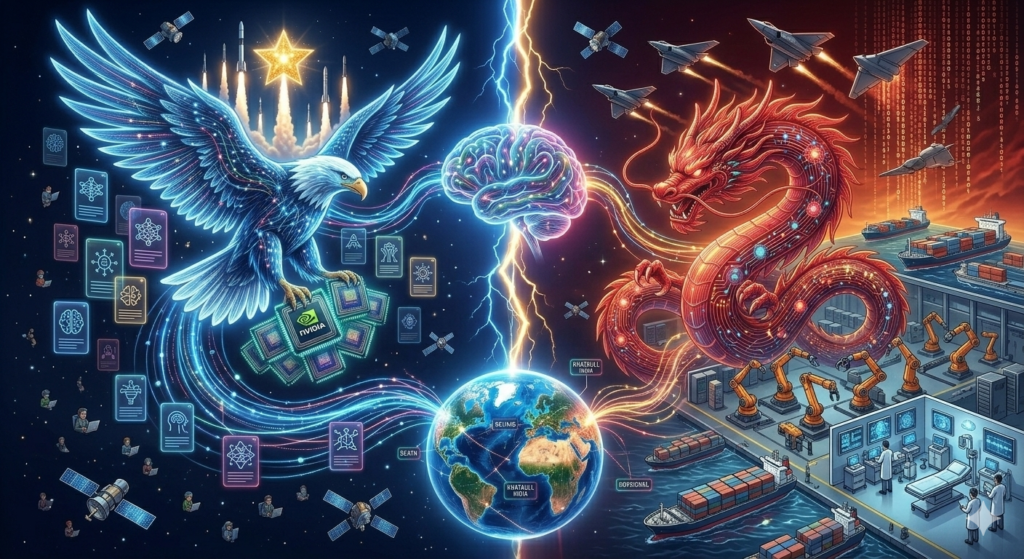
Table of Contents
1. Setting the Stage: Why the China vs USA AI Race Matters
The China vs USA AI race who is winning 2026 is not simply a technology competition between two rival corporations or research labs. It is a geopolitical contest that will determine which country leads the global economy, dominates military strategy, sets international technology standards, and shapes the values embedded in the AI systems that will govern everyday life for billions of people by 2035.
The stakes have never been higher. AI is already accelerating a revolution in military affairs, particularly in the cyber domain and in battlefield autonomy. AI agents are driving productivity gains across industries — from manufacturing and logistics to healthcare and finance. Whoever leads in AI will have an asymmetric advantage in economic growth, scientific discovery, national security, and geopolitical influence for decades.
Trump’s AI czar David Sacks put it plainly in early 2026: “China is not years and years behind us in AI. Maybe they’re three to six months.” That assessment — from inside the White House — is a remarkable admission of how competitive this race has become, and how recently the comfortable American lead began to narrow.
The DeepSeek moment of early 2025 was the inflection point. When a small Chinese AI lab called DeepSeek released a model that matched GPT-4 performance at a tiny fraction of the training cost, it shattered the assumption that America’s massive chip and capital advantages were decisive. If China could build world-class AI with constrained resources, the entire strategic calculus needed to be rewritten.
The following comparison examines nine distinct dimensions of the China vs USA AI race who is winning 2026. Each tells a different story.
2. The Scoreboard: Head-to-Head Comparison at a Glance
Before diving into the detail, here is the comprehensive side-by-side data comparison:
| Dimension | USA | China | 2026 Leader |
|---|---|---|---|
| Frontier AI Models | GPT-5, Gemini 3.1, Claude Opus 4.6 | DeepSeek V4, Qwen 3.5, Baidu Ernie 5 | USA |
| AI Compute Capacity | ~50% of global high-end AI compute | ~14% of global high-end AI compute | USA |
| Private AI Investment (2024) | $109.1 billion | $9.3 billion | USA (12x more) |
| AI Research Papers (2024) | ~16,000 high-impact papers | ~23,700 papers published | Tie |
| AI Patents Filed (2024) | ~28,000 | ~35,000+ | China |
| Industrial Robot Deployment | Moderate | More than rest of world combined | China |
| AI Chip Production | NVIDIA leads globally | Constrained by US export controls | USA |
| AI Deployment at Scale | Strong in enterprise software | Leading in manufacturing, logistics, ports | China |
| Public Trust in AI | Low — citizens skeptical | High — citizens broadly accepting | China |
| Open-Source AI Strategy | Mixed — no national strategy | Fully embraced as national strategy | China |
| Military AI Investment | $1.8B+ federal AI budget | Military-Civil Fusion — fully integrated | Disputed |
| AI Talent Pool | Leads globally in top AI researchers | Leads in total STEM graduates | Tie |
| National AI Policy | Fragmented — private sector led | Unified — state-directed and fully funded | China |
| Rare Earth Control | Dependent on China | Controls 80%+ of global supply | China |
| Top AI Company Valuations | Magnificent Seven: $12T+ combined | BATX combined: $1.22T (less than Tesla alone) | USA |
3. Round 1 — AI Models and Frontier Research: USA Leads
On the question of who is building the world’s most capable AI models, the answer in 2026 is unambiguous: the United States.
The world’s most capable large language models and multimodal systems are produced by American firms. OpenAI’s GPT-5, Google’s Gemini 3.1 Pro, and Anthropic’s Claude Opus 4.6 demonstrate superior reasoning and tool-use capabilities — including autonomously writing and debugging code, querying live databases, and analyzing complex multi-modal documents. They anchor the most commercially valuable AI services globally and set the benchmarks that every other lab in the world aims to match.
China’s best models — DeepSeek V4, Alibaba’s Qwen 3.5, and Baidu’s Ernie 5 — are genuinely impressive and have narrowed the gap dramatically since the DeepSeek shock of early 2025. At a landmark AI summit in Beijing in early 2026, Chinese AI leaders were asked directly: what are the chances of a Chinese firm overtaking American frontrunners within three to five years? The room was divided. Nobody said impossible.
On raw research volume, China actually leads: it published approximately 23,700 AI-related papers in 2024 compared to roughly 16,000 from the United States. But American papers disproportionately represent the highest-cited, highest-impact work that defines the frontier. Quality versus quantity remains the defining contrast in this dimension.
Winner: USA — but the lead is narrowing faster than most Americans realize.
4. Round 2 — Compute Power and Semiconductors: USA Leads (But Grip Is Slipping)
Compute — the processing power required to train and run advanced AI models — is, according to leading researchers, the single biggest driver of AI progress right now. And on compute, the United States has a structural, decisive advantage.
American firms control roughly 50% of global high-end AI supercomputing capacity. Chinese firms control approximately 14%. NVIDIA’s GPUs — the H100, H200, and the new Blackwell B200 architecture — remain the gold standard for AI training globally, and American export controls have been specifically designed to prevent China from accessing them.
As DeepSeek CEO Liang Wenfeng stated bluntly: “Money has never been the problem for us; bans on shipments of advanced chips are the problem.” The US export control regime is working exactly as intended — creating a compute ceiling above which Chinese AI labs cannot easily climb without building their own domestic chip supply chain.
However, two important caveats complicate this picture. First, China’s domestic chip production is advancing rapidly. Huawei’s Ascend AI chips are improving with each generation, and China’s national semiconductor investment is unprecedented in scale. Second, export rules announced by the Trump administration in early 2026 could give Chinese companies access to up to 890,000 of NVIDIA’s H200 chips — more than double what Chinese manufacturers are expected to produce domestically in 2026. If that loophole is not closed, the US compute advantage could dwindle significantly within two years.
Winner: USA — but the chip export control regime is the single most critical variable in this entire competition.
5. Round 3 — Investment and Funding: USA Dominates
The capital gap between the two countries is staggering and consistent. Stanford University reports that US private AI investment reached $109.1 billion in 2024 — almost twelve times China’s $9.3 billion.
The contrast in corporate valuations tells the same story with even greater force. As of January 2, 2026, the combined market capitalization of China’s four largest tech companies — Baidu, Alibaba, Tencent, and Xiaomi (BATX) — was $1.22 trillion. The single lowest-valued company in America’s Magnificent Seven was Tesla at $1.46 trillion. NVIDIA alone was valued at more than four times the entire BATX group combined.
OpenAI’s recent $110 billion funding round — backed by Amazon ($50B), NVIDIA ($30B), and SoftBank ($30B) — is a single transaction that dwarfs China’s entire national annual AI investment. The private capital markets of the United States represent a structural advantage that state direction alone cannot replicate, no matter how coordinated Beijing’s industrial policy becomes.
Winner: USA — by a commanding margin that is unlikely to close within this decade.
6. Round 4 — Real-World Deployment and Scale: China Leads
Here is where the conventional American narrative gets seriously disrupted — and where the most important story of the China vs USA AI race is actually being told.
On deployment and public trust in AI, China may be years ahead of the United States. Beijing treats AI as infrastructure — not as a product category. Through top-down industrial policy and deep integration of design and production, China has deployed AI across manufacturing, ports, power grids, hospitals, and consumer products at a scale that has no parallel anywhere in the Western world.
The numbers are extraordinary. China has leapfrogged both Germany and Japan in robot density and now deploys more industrial robots than the rest of the world combined. Across the maritime sector, Beijing operates 18 fully automated port terminals, with a further 27 under construction — slashing cargo turnaround times and tightening global supply chain efficiency. In renewable energy, AI-driven grid management has cut power outage durations from 10 hours to just three seconds. In healthcare, Tsinghua University’s Agent Hospital uses virtual AI doctors to diagnose and treat thousands of patients daily with 93% accuracy.
This deployment advantage is reinforced by a powerful cultural factor: Chinese citizens are far more willing to accept AI than Western publics. Surveys consistently show dramatically higher public trust in AI across China, shaped by decades in which technology visibly improved daily life. Western societies often frame AI as a threat to jobs and privacy. Chinese citizens largely see it as national progress.
Winner: China — and this deployment advantage may ultimately matter far more than who has the more impressive research paper.
7. Round 5 — Talent and Workforce: USA Leads Globally, China Leads Domestically
The talent dimension of the China vs USA AI race who is winning 2026 is rapidly shifting — in China’s favour.
The United States currently leads in attracting and retaining the world’s top AI researchers. America’s universities — MIT, Stanford, Carnegie Mellon, Berkeley — produce disproportionate shares of the world’s most-cited AI research. Roughly a third of the leading AI researchers working in the United States are foreign-born, drawn by opportunity, funding, and academic freedom.
But this advantage is being actively eroded on multiple fronts. Funding cuts at US research institutions have prompted many researchers to consider moving. A wave of China-born scientists has left the United States to return home in the past year, including former Harvard mathematician Liu Jun and former Intel chip architect Su Fei. China’s “Thousand Talents” programme offers substantial financial and professional incentives for overseas researchers to return.
On volume, China’s advantage is unambiguous. China produces the world’s largest number of STEM graduates annually — a pipeline powering its AI workforce for decades. The US advantage is concentrated in the quality of its top-tier talent; China’s advantage is in the depth and sheer scale of its STEM production base.
Winner: Tie — the US leads on elite research talent; China leads on volume and is actively and successfully closing the quality gap.
8. Round 6 — Military AI and Defense: Too Close to Call
Military AI represents perhaps the highest-stakes and least transparent dimension of the China vs USA AI race. Both sides are investing heavily, but their approaches are structurally different in ways that make direct comparison difficult.
The United States has made military AI a top priority through its January 2026 AI Acceleration Strategy — allocating $1.8 billion for AI and machine learning initiatives and launching seven pace-setting projects including autonomous drone swarms (Swarm Forge), AI-powered intelligence analysis (Open Arsenal), and kill chain acceleration tools (Agent Network). The Iran-Israel conflict of 2026 has served as a live testing ground for American and Israeli military AI capabilities, with real-world validation of targeting systems, drone coordination, and cyber warfare tools.
China’s approach is structurally different and arguably more deeply integrated. Under its Military-Civil Fusion doctrine, every AI advance made by a Chinese civilian company — Huawei’s chip development, Baidu’s autonomous vehicle research, DJI’s drone technology — simultaneously advances the People’s Liberation Army’s capabilities. There is no meaningful separation between civilian and military AI development in China. Every technology is born dual-use.
Winner: Disputed — the US leads on currently deployed operational capability; China leads on structural depth and long-term integration.
9. Round 7 — Open-Source AI Strategy: China’s Surprise Weapon
This is perhaps the most strategically underappreciated dimension of the entire China vs USA AI race in 2026.
China has made open-source AI a flagship national strategy — a deliberate choice to commoditize the AI model layer entirely and compete on deployment infrastructure, data integration, and standards instead. By making powerful AI models freely available globally, China aims to build worldwide dependency on Chinese AI platforms, frameworks, and technical standards — while simultaneously removing the cost barrier that has given US proprietary models their commercial advantage.
DeepSeek’s open-source release strategy already demonstrated the power of this approach. Within weeks of its release, DeepSeek models were running on servers across Europe, Southeast Asia, and the Middle East — building global familiarity with Chinese AI technology at zero cost to Beijing and at significant cost to OpenAI’s subscription revenue.
The United States, by contrast, has no coordinated national open-source AI strategy. The field is divided between open-source advocates like Meta (Llama series) and closed-source leaders like OpenAI and Anthropic. This incoherence leaves a strategic opening that China is exploiting with precision.
Winner: China — a quiet strategic masterstroke that the United States currently has no coherent response to.
10. Round 8 — AI Policy and Governance: Two Completely Different Philosophies
The policy frameworks shaping the China vs USA AI race reflect two fundamentally different visions of what AI is for and how society should be organised around it.
The United States operates a primarily private-sector-led model. Federal AI policy sets broad guidelines, but the actual decisions about what to build, how fast to deploy it, and what safeguards to maintain are made by competing private companies. This creates speed, diversity, and innovation — but also fragmentation, conflicting interests, and the kind of ethical disputes over military AI that dominated headlines in February 2026.
China operates a state-directed model. The Communist Party sets specific, measurable, funded targets — 90% economic AI integration by 2030 — and mobilises the entire apparatus of the state to achieve them. This creates deployment speed and policy coordination that no democratic country can match. It also concentrates control over the world’s most powerful AI systems in a single government with no independent oversight or democratic accountability.
Winner: Depends entirely on values. China wins on coordination speed and deployment certainty. The USA wins on accountability, innovation diversity, and the ability to course-correct when AI causes harm.
11. Round 9 — Data and Infrastructure: China’s Structural Advantage
Data is the raw material of AI. China has a structural data advantage that no amount of American investment can easily replicate: 1.4 billion people generating data across a single regulatory jurisdiction, with minimal privacy restrictions on how that data can be collected, aggregated, and used to train AI systems.
China’s national integrated data market — explicitly mandated in the 15th Five-Year Plan — will give Beijing centralised visibility into AI training data, model outputs, and deployment patterns across the entire economy. That level of data integration has no equivalent anywhere in the democratic world.
China also controls over 80% of the world’s rare earth elements — the minerals critical to producing AI chips, electric vehicles, and defense electronics. This is not a soft advantage. In early 2026, in direct response to US chip export controls, China announced new export restrictions on rare earths and critical minerals. Trump responded by threatening new tariffs. This minerals-for-chips leverage dynamic is one of the most consequential and underreported elements of the China vs USA AI race in 2026.
Winner: China — data volume, data access, and critical mineral control are durable structural advantages that persist regardless of which company builds the best model.
12. The Verdict: Who Is Actually Winning the China vs USA AI Race in 2026?
The honest, data-backed answer is: it depends entirely on which race you are measuring.
Where the USA Clearly Leads
- Building the world’s most capable frontier AI models
- Controlling the world’s most powerful AI chips through NVIDIA
- Private sector AI investment — 12 times larger than China’s
- Attracting the world’s highest-quality AI research talent
- Commercial AI platform reach — ChatGPT, Google AI, Microsoft Copilot
Where China Clearly Leads
- Deploying AI at industrial scale across the physical economy
- Open-source AI as a global distribution and standards strategy
- Military-Civil AI Fusion — no democratic equivalent exists
- Public acceptance and trust in AI systems domestically
- Rare earth and critical mineral leverage over global AI supply chains
- State coordination speed for achieving national AI targets
- Total AI patent filings and domestic STEM graduate production
The Uncomfortable Strategic Truth
The most plausible outcome of the China vs USA AI race in 2026 is not a decisive American victory or a Chinese upset. It is asymmetric AI bipolarity — a world where both nations lead simultaneously in different dimensions, neither able to fully dominate, and neither able to fully ignore the other.
As CSIS analysts concluded: “The question is not who wins the race, but whether either can finish without the other’s capabilities.” Both countries are pursuing strategies attuned to their unique domestic systems — but both strategies are incomplete without elements of the other.
The United States still enjoys a clear advantage at the cutting edge of AI. China enjoys a clear advantage in deployment breadth and national coordination. The country that ultimately prevails will not be the one that built the best model in a research lab. It will be the one that most effectively embeds AI into every factory floor, every hospital, every military operation, and every government service — and earns the trust of its citizens to let it do so.
On that second measure — deployment at civilisational scale — China is not behind. It may already be ahead.
13. Key Takeaways: China vs USA AI Race Who Is Winning 2026
- USA leads in frontier AI models, compute power, private investment ($109B vs $9.3B), and global AI talent attraction
- China leads in real-world deployment, industrial automation, open-source strategy, data volume, rare earths, and patent filings
- The DeepSeek moment of 2025 proved that compute constraints alone cannot stop Chinese AI innovation
- China’s 15th Five-Year Plan — 52 AI mentions, 90% economic integration target — is the most ambitious national AI programme in history
- Military AI is structurally integrated in China through Military-Civil Fusion; the US is building capability faster but from a more fragmented base
- AI chips remain the critical chokepoint — US export controls are the single most important policy lever in this entire competition
- Rare earths are China’s most powerful counter-lever — and Beijing has shown it is willing to use them
- Neither country will achieve clear dominance — AI bipolarity, not AI supremacy, is the most likely 2026–2030 outcome
- The real race is deployment, not research — whoever embeds AI most deeply into its economy and military will hold the strategic advantage