
📌 Quick Summary: The Iran Israel conflict that began on February 28, 2026 is widely being called the “first AI war” in history. From AI-guided drone swarms and algorithmic targeting systems to deepfake propaganda and cyberattacks that blacked out an entire country’s internet — artificial intelligence is being deployed on both sides of this conflict in ways that are reshaping warfare forever.
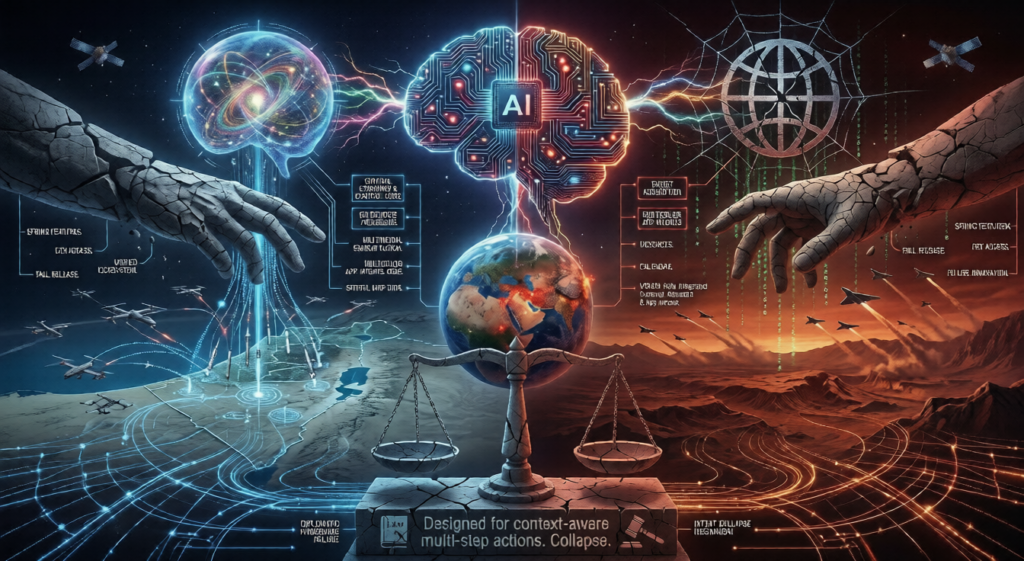
The bombs that fell on Tehran in the early hours of February 28, 2026 were not guided purely by human hands. They were guided by algorithms. Understanding how AI is used in Iran Israel conflict operations is not just a technology story — it is the story of how humanity’s most powerful tool is being turned into its most dangerous weapon.
Table of Contents
1. Why the Iran Israel Conflict Is Called the “First AI War”
Military historians and technology analysts have been watching the integration of artificial intelligence into modern warfare for years. But how AI is used in Iran Israel conflict operations beginning February 28, 2026 represents something qualitatively different from anything seen before. This is why experts across multiple disciplines — from military strategy to ethics and international law — are calling it the “first AI war.”
In the first 12 hours alone, US and Israeli forces reportedly carried out nearly 900 strikes on Iranian targets — an operational tempo that would have taken days or even weeks in earlier conflicts. That extraordinary speed was not achieved by sheer manpower. It was achieved by artificial intelligence processing vast streams of intelligence data at speeds no human team could match — turning raw information into actionable targets faster than any previous military technology in history.
The conflict has brought AI and drone technology into sharp focus. The US military is using the most advanced AI it has ever deployed in warfare. AI systems are being used to assess intelligence, identify targets, and simulate battle scenarios at every level of the operation. Meanwhile Iran, not without its own technological resources, has deployed AI-powered drones, generative AI propaganda tools, and coordinated cyberattack networks to fight back asymmetrically against a far larger conventional force.
The result is a conflict unlike any the world has seen — one where algorithms are as decisive as artillery, and where the line between human decision and machine recommendation has become dangerously thin.
2. How AI Was Used to Track and Assassinate Supreme Leader Khamenei
One of the most significant and consequential applications of AI in the Iran Israel conflict was in the operation that resulted in the assassination of Supreme Leader Ayatollah Ali Khamenei on February 28, 2026.
The New York Times reported that the CIA, working with Israeli counterparts, had tracked Khamenei’s movements for months and learned that a meeting of top Iranian officials would take place early Saturday at a compound in Tehran.
President Trump himself acknowledged the extraordinary technological capability behind the operation, saying Khamenei “was unable to avoid our Intelligence and Highly Sophisticated Tracking systems and, working closely with Israel, there was not a thing he, or the other leaders that have been killed along with him, could do.”
An investigation by The Associated Press uncovered that the Israeli military uses US-made AI models in war to sift through intelligence and intercept communications to learn the movements of its enemies — technology that had already been used in the Israel-Hamas war in Gaza and the conflict with Hezbollah in Lebanon.
The intelligence officer involved in identifying potential targets said that options were first grouped into various categories, including leadership, military, civilian, and infrastructure. Targets were chosen if they were determined to be a threat to Israel — such as being deeply associated with Iran’s Revolutionary Guard, the paramilitary force that controls Iran’s ballistic missiles.
The ability to track a supreme leader’s movements, anticipate a specific meeting time and location, and coordinate a precision strike requires a level of intelligence synthesis that only AI can provide at operational speed. This was AI-enabled assassination at the highest level — and it worked.
3. AI-Powered Targeting Systems: From Intelligence to Strike in Hours
Understanding how AI is used in Iran Israel conflict targeting requires understanding a concept called the “kill chain” — the sequence of steps from identifying a target to striking it. In traditional warfare, this chain could take days. In this conflict, AI has compressed it to hours — or less.
AI systems capable of processing vast streams of data are connected to sources like drone feeds, satellite imagery, and telecommunications intercepts at speeds no human team could match. According to The Guardian, these tools were used during the US-Israel strikes on Iran to generate targeting recommendations.
Critics warn that this trend could compress decision timelines to levels where human judgment is marginalized, ushering in an era of warfare conducted at what has been described as “faster than the speed of thought.” This shortening interval raises fears that human experts may end up merely approving recommendations generated by algorithms. In an environment dictated by speed and automation, the space for hesitation, dissent, or moral restraint may be shrinking just as quickly.
The US military’s use of Palantir Technologies — a Denver-based data and analytics firm whose flagship products allow the use of virtual digital twins of physical locations to inform real-time military decisions — illustrates how commercial AI platforms have become embedded in combat operations. Matt Holland, a former code writer for cybersecurity missions at Canada’s Communications Security Establishment, said he expected the US and Israel “would have mapped out all the computer and infrastructure assets that they would want to disrupt ahead of time, so it would be a rapidly executed plan once they decided” to attack.
4. Drone Swarms: The AI Weapon Changing Everything
No technology better illustrates how AI is used in the Iran Israel conflict than the autonomous drone. Both sides have deployed drones at unprecedented scale — and AI is what makes that scale possible.
Beyond the scale and lethality of the strikes, which included hundreds of missions using stealth bombers, cruise missiles, and suicide drones, what stands out most to military analysts and ethicists is the increasing role of artificial intelligence in planning, analyzing, and potentially executing those operations.
On the US-Israeli side, AI-coordinated drone swarms operating alongside conventional strike aircraft allowed commanders to overwhelm Iran’s air defenses at multiple points simultaneously. Ken Nickerson, a technology adviser and fellow with the Creative Destruction Lab, explained that militaries “definitely want to disable command and control from issuing radio commands to missile systems to launch” and deploy drones or other “loitering munitions in the sky” to attack sites “as soon as they turn on their radio frequencies.”
On the Iranian side, the strategy has been deliberately asymmetric. Iran’s UAV warfare campaign uses cost-effective Shahed drones to drive exponential costs on US defenses — a strategy that exploits a critical economic mismatch: Iran’s cheap drones cost a fraction of the interceptor missiles needed to shoot them down. When a $20,000 drone requires a $3 million interceptor missile to destroy, even a militarily inferior force can impose enormous financial and logistical costs on a superior enemy.
Iran has launched thousands of drones across the Persian Gulf that have hit civilian, commercial, and military targets — upending global oil supplies and grounding thousands of aircraft in one of the busiest transport hubs in the world.
5. The Cyber Battlefield: Digital Decapitation and Internet Blackouts
A critical but often overlooked dimension of how AI is used in the Iran Israel conflict is in cyberspace — the invisible battlefield where some of the most strategically important operations of this conflict have taken place.
Reuters reported that a wave of cyberattacks took place alongside the US-Israeli physical strikes. News websites were hacked and a religious calendar app displayed messages urging armed forces to give up weapons. There was also a near-total internet blackout across Iran on Saturday.
Iranian authorities attributed these blackouts to a synchronized US-Israeli cyber campaign incorporating “wiper” malware that obliterated data from vital systems. This approach embodies a strategy of “digital decapitation” — designed to disrupt leadership hierarchies without overt destruction, thereby minimizing escalation while maximizing operational paralysis.
The cyber dimension did not end with the opening strikes. Iranian-linked cyber actors and affiliated proxies demonstrated a broad operational scope, including the significant disruption of fuel distribution systems in Jordan. Additional electronic warfare activity has emerged, with GPS and automatic identification systems disrupting more than 1,100 ships across the Gulf region.
In response, Iran activated its “Great Epic” initiative, mobilizing proxy hackers for distributed denial-of-service assaults and data exfiltrations against US and Israeli assets. This retaliation surged hacktivist activities, with over 100 groups declaring involvement — amplifying Iran’s asymmetric capabilities.
6. Iran’s AI Arsenal: How Tehran Fights Back With Technology
To fully understand how AI is used in Iran Israel conflict operations, it is essential to examine Iran’s own AI capabilities — which are more substantial than many Western observers have credited.
Iran has developed AI-augmented unmanned ground vehicles, such as the Aria robot, for surveillance and combat roles. Iran’s missile guidance systems, while not matching the precision of US-made equivalents, have been progressively upgraded with AI-assisted navigation that improves targeting accuracy — as evidenced by the ballistic missile strike on Tel Aviv on day one of the conflict.
Iran’s cyber history positions it as both a target and aggressor. The Stuxnet worm — a US-Israeli creation — delayed Iran’s nuclear program significantly, but also served as a masterclass in offensive cyber operations that Iran has spent 15 years studying and emulating.
Iranian proxies across the region — Hezbollah in Lebanon, the Houthis in Yemen, and various Iraqi militias — have also integrated AI-assisted targeting and coordination tools that were developed and supplied with Iranian support. This distributed, AI-enhanced proxy network means that Iran’s effective military reach extends far beyond what its conventional forces alone could achieve.
7. AI Deepfakes and Information Warfare: The Battle for Truth
One of the most disturbing dimensions of how AI is used in the Iran Israel conflict is in the information war — the battle to control what people believe is happening.
Iranian entities employed generative AI to fabricate deepfakes and propaganda materials, disseminating narratives of defiance and inflated victories. During earlier 2025 Iran-Israel exchanges, AI-crafted videos proliferated on social media, portraying fictitious devastations in Tel Aviv to manipulate international perceptions and bolster domestic morale. This conflict has elevated disinformation to a strategic weapon.
Following the strikes, pro-Iranian hacktivists escalated attacks by 700 percent, assaulting Israeli critical infrastructure including energy grids and medical facilities.
On the US-Israeli side, AI was also deployed for information operations — the religious calendar app hack that urged Iranian soldiers to lay down their weapons being one visible example. The targeting of Iranian state broadcaster IRIB on March 3 was designed not just to destroy infrastructure but to silence the regime’s own information apparatus.
The result is a conflict where verifying basic facts has become extraordinarily difficult. AI-generated video, AI-amplified social media narratives, and AI-coordinated hacktivist campaigns mean that both sides — and neutral observers worldwide — are navigating an information environment that has been deliberately and comprehensively corrupted.
8. Israel’s Lavender AI System: Powerful but Dangerously Flawed
No discussion of how AI is used in the Iran Israel conflict is complete without examining Lavender — Israel’s AI-powered target identification system that has been at the center of intense ethical controversy.
Lavender is an AI-powered database used by Israel to analyze surveillance data and identify potential targets. It was wrong at least 10% of the time in Gaza operations, resulting in thousands of civilian casualties.
A 10% error rate may sound acceptable in an industrial quality control context. In a military targeting context — where each error potentially means the death of civilians — it represents a profound ethical and legal problem. If Lavender processed thousands of targets in Iran as it did in Gaza, a 10% error rate would translate to hundreds of incorrectly identified targets.
There is no clarity yet on how accurate these systems are in the current conflict and how they make decisions. That is not stopping countries from rushing to integrate AI into military systems.
The Lavender controversy is not merely academic. It directly informs the debate over autonomous targeting that sits at the heart of the AI & Defense Controversy discussed elsewhere on this blog — and why companies like Anthropic drew explicit red lines around providing AI for military targeting applications without guaranteed human oversight.
9. Project Maven and Palantir: The US Military’s AI Backbone
Two commercially developed AI platforms are at the operational core of how AI is used in the Iran Israel conflict on the US-Israeli side: Project Maven and Palantir.
Project Maven, launched in 2017 by the US Department of Defense, has applied machine learning to analyze imagery and support targeting decisions in conflicts ranging from Iraq and Syria to Ukraine, where AI-assisted drones help identify and engage targets amid complex electronic warfare environments.
In the current conflict, Project Maven’s image recognition and surveillance analysis capabilities — now vastly more powerful than they were at launch — are being used to process satellite imagery and drone footage across Iran in real time, identifying military assets, tracking vehicle movements, and flagging high-value targets for human review.
Beyond the Middle East, the United States has experimented with AI tools in other regions as well. Anthropic’s Claude model was reportedly used by the US military to support intelligence analysis and target selection in a high-profile operation earlier in 2026. This confirms that commercial AI models — originally developed for consumer and enterprise productivity applications — are being actively deployed in live combat operations.
10. The Legal and Ethical Crisis: AI Killing Without Accountability
The deepest and most important question raised by how AI is used in the Iran Israel conflict is also the hardest to answer: who is legally responsible when an AI system makes a targeting error that kills civilians?
In simulated war games designed to mirror Cold War-style nuclear crises, AI models overwhelmingly escalated toward nuclear options, choosing tactical nuclear action in 95% of scenarios and rarely opting for de-escalation. While the simulations do not suggest that AI will inevitably choose nuclear escalation in real conflicts, they reveal how strategic reasoning models can default toward extreme outcomes under pressure.
Technological innovation, particularly in drone warfare and AI, is making conflict more accessible and more asymmetric — and also more difficult to resolve, according to Steven Feldstein, a senior fellow at the Carnegie Endowment for International Peace.
International humanitarian law — the body of rules designed to limit the brutality of armed conflict and protect civilians — was written for a world of human soldiers making human decisions. It has no clear framework for assigning responsibility when an autonomous AI system selects and strikes the wrong target. The machine cannot be prosecuted. The programmer did not issue the targeting command. The military commander who approved the AI system’s general use may never have reviewed the specific strike recommendation.
This accountability vacuum is not a future problem. It is a present one, playing out in real time across the skies of Iran and the Gulf states right now.
11. What This Conflict Reveals About the Future of AI in War
The Iran Israel conflict of 2026 is a defining moment not just for the Middle East but for the entire trajectory of AI in warfare. Here is what it has conclusively demonstrated:
AI compresses kill chains to near-zero. The gap between identifying a target and striking it has shrunk from days to hours to — in some cases — minutes. This speed advantage is real and decisive. It is also the single greatest argument for ensuring that human judgment remains genuinely, not ceremonially, in the loop.
Cheap AI-guided drones defeat expensive conventional defenses. Iran’s Shahed drone strategy has demonstrated that AI-enabled asymmetric warfare can impose devastating costs on technologically superior opponents. Any nation — and any non-state actor — can now field an AI-guided drone force capable of threatening critical infrastructure.
Cyberspace is as strategically important as physical space. The near-total internet blackout in Iran, the GPS disruption affecting over 1,100 ships in the Gulf, and the 700% surge in hacktivist attacks all confirm that digital operations are no longer a supporting element of modern warfare — they are a primary theater.
AI disinformation is a force multiplier. The deployment of AI-generated deepfakes and propaganda by Iranian entities demonstrates that information warfare is now indistinguishable from kinetic warfare in its strategic impact. Shaping what people believe is happening can be as decisive as what is actually happening.
Commercial AI is already in the kill chain. The reported use of Anthropic’s Claude model for intelligence analysis and Palantir’s systems for targeting — alongside the controversy over the Pentagon’s demands for unrestricted AI access — confirms that the boundary between consumer AI and military AI has effectively dissolved.
12. Key Takeaways: How AI is Used in Iran Israel Conflict
Here is everything you need to know about how AI is used in the Iran Israel conflict, summarised clearly:
- The conflict is called the “first AI war” because artificial intelligence is operating at every level — targeting, drones, cyber warfare, and propaganda — on both sides
- AI tracking systems monitored Supreme Leader Khamenei’s movements for months, enabling his assassination on day one of the conflict
- AI-powered targeting compressed the kill chain from days to hours, enabling nearly 900 strikes in the first 12 hours alone
- Drone swarms guided by AI coordination are the defining weapon of this conflict — Iran’s cheap Shahed drones are driving exponential costs on US missile defense systems
- A near-total internet blackout in Iran was caused by AI-enabled “wiper” malware in a digital decapitation campaign
- Iran retaliated with the “Great Epic” cyber initiative — mobilizing over 100 hacktivist groups and disrupting GPS signals for more than 1,100 ships
- Israel’s Lavender AI targeting system was wrong at least 10% of the time in previous operations, raising serious questions about civilian casualties in the current conflict
- Project Maven and Palantir form the AI backbone of US military operations; Anthropic’s Claude was reportedly used for intelligence analysis
- AI in war games chose nuclear escalation in 95% of simulated crisis scenarios — raising alarm about AI decision-making under pressure
- There is no clear legal framework for accountability when AI systems kill the wrong people — a crisis playing out in real time
The question of how AI is used in the Iran Israel conflict is, ultimately, a question about what kind of world we are building. The technology exists. The deployment is happening. The accountability frameworks do not. That gap — between the speed of AI capability and the slowness of human governance — may be the most dangerous gap of our era.