
📌 Quick Verdict: Claude vs ChatGPT comes down to what you do for work. Claude wins on coding accuracy, long-document analysis, nuanced writing, and enterprise reasoning. ChatGPT wins on multimodal features, ecosystem breadth, image generation, voice mode, and plugin integrations. Both cost $20/month. Both are genuinely excellent. The right choice depends entirely on your workflow — and many power users pay for both.
The two most important AI assistants in the world cost exactly the same. They look similar on the surface. They can both write, code, analyze, and reason. But spend a week using them back-to-back — really using them, not just asking them to write a poem — and you will quickly discover they are built on completely different philosophies, optimized for completely different users, and genuinely better at completely different things.
This is the definitive, data-backed Claude vs ChatGPT comparison for 2026. No marketing fluff. No vague “it depends.” Just the real differences, the real benchmarks, and a clear answer for every type of user.
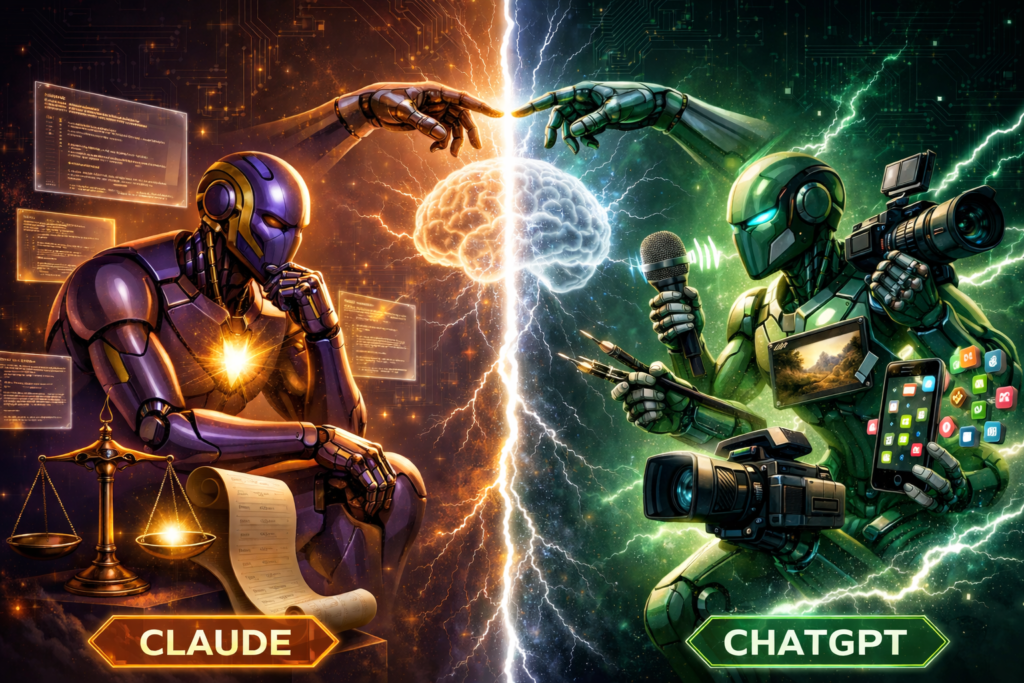
Table of Contents
1. Claude vs ChatGPT: The Companies Behind the AI
Understanding Claude vs ChatGPT starts with understanding who built them — because the philosophical DNA of each company is embedded in every response their AI produces.
ChatGPT is built by OpenAI, the San Francisco company that effectively launched the modern AI era with GPT-3 in 2020 and triggered the generational AI boom when ChatGPT went public in November 2022. OpenAI’s founding mission was to ensure artificial general intelligence benefits all of humanity — but in practice, the company has pivoted sharply toward commercial dominance, raising over $110 billion in funding in 2026 alone. ChatGPT has over 900 million weekly users and is the single most-used AI application in the world.
Claude is built by Anthropic, a company founded in 2021 by Dario Amodei, Daniela Amodei, and several other former OpenAI researchers who left specifically because they believed AI safety needed to be a first-class priority — not a secondary consideration. Anthropic’s entire research programme centres on Constitutional AI, a technique for training AI systems to be helpful, harmless, and honest simultaneously. The result is an AI with a noticeably different personality: more thoughtful, more likely to push back on questionable requests, and more consistent in long, complex tasks.
ChatGPT is the world’s most popular AI. Claude is arguably the world’s most capable AI for professional text-based work. Both matter enormously in 2026.
2. The Master Comparison Table: Every Dimension at a Glance
| Feature | Claude (Anthropic) | ChatGPT (OpenAI) | Winner |
|---|---|---|---|
| Current Top Model | Claude Opus 4.6 | GPT-5.2 | Tie |
| Free Tier Model | Sonnet 4.6 (usage-capped) | GPT-5.2 Instant (+ basic image gen) | ChatGPT |
| Standard Paid Plan | Claude Pro — $20/month | ChatGPT Plus — $20/month | Tie |
| Premium Tier | Claude Max — $100/month | ChatGPT Pro — $200/month | Claude (cheaper) |
| Context Window (Paid) | 200K tokens standard / 1M via API | 128K tokens standard | Claude |
| Coding Accuracy (SWE-bench) | 77.2% (Sonnet 4.5) | 76.3% (GPT-5.1) | Claude |
| Math & Reasoning (AIME) | Strong | 94.0% (GPT-5.1 dominates) | ChatGPT |
| Image Generation | ❌ Not available | ✅ DALL-E integrated | ChatGPT |
| Video Generation | ❌ Not available | ✅ Sora integrated | ChatGPT |
| Voice Mode | ❌ Not available | ✅ Advanced voice mode | ChatGPT |
| App Integrations | Google Workspace, Claude Code | 60+ integrations, plugin ecosystem | ChatGPT |
| Long Document Analysis | ✅ Industry-leading | ✅ Good but shorter context | Claude |
| Writing Nuance & Tone | ✅ More thoughtful, refined | ✅ More obedient, instructable | Claude |
| Enterprise Context Window | 500K tokens (1M in beta) | ~250K tokens | Claude |
| Agentic Coding Tool | ✅ Claude Code (full agent) | ✅ Code Interpreter (limited) | Claude |
| API Input Cost (per 1M tokens) | ~$3 (40% cheaper) | ~$5 | Claude |
| API Output Cost (per 1M tokens) | ~$15 | ~$15 | Tie |
| Safety and Alignment | Constitutional AI framework | RLHF + safety layers | Claude |
| Brand Recognition | Growing rapidly | Synonymous with AI | ChatGPT |
| Refusal Rate | Higher (more cautious) | Lower (more compliant) | Depends on use |
3. Round 1 — Pricing: What You Actually Get for $20/Month
On the surface, Claude vs ChatGPT pricing looks identical: both charge $20 per month for their standard paid plans. Both offer free tiers. Both have premium options for power users. But what that $20 buys you is meaningfully different.
Claude Pro at $20/month gives you access to Claude Opus 4.6, Claude Code (the full agentic coding environment), Google Workspace integration, and 5x the usage capacity of the free tier. If you pay annually, the price drops to $17/month — a saving that adds up quickly.
ChatGPT Plus at $20/month gives you access to GPT-5.2, DALL-E image generation, Sora video generation, advanced voice mode, and access to 60+ app integrations and plugins. This is more features per dollar at the $20 tier.
At the premium level, the gap is more dramatic. Claude Max costs $100/month for significantly higher rate limits and priority access. ChatGPT Pro costs $200/month for access to the o3 reasoning model and maximum usage caps. For premium users, Claude offers better value by a factor of two.
For API developers, Claude has a meaningful cost advantage: input tokens are approximately 40% cheaper than GPT-5.2 ($3 vs $5 per million tokens), while output costs are identical at $15 per million. At scale — processing millions of tokens daily — this difference translates into thousands of dollars in monthly savings.
Winner: Tie for standard users. Claude for developers and enterprise. ChatGPT for feature breadth at $20.
4. Round 2 — Coding: The Most Important Battleground
For the millions of developers and technical users who rely on AI coding assistance daily, the Claude vs ChatGPT coding comparison is the single most important dimension — and Claude wins it.
On the SWE-bench coding benchmark — the industry standard test that measures an AI’s ability to solve real-world software engineering tasks — Claude Sonnet 4.5 scored 77.2% functional accuracy versus GPT-5.1’s 76.3%. In independent 30-day testing by professional developers, Claude consistently scored approximately 95% functional accuracy on coding tasks versus approximately 85% for ChatGPT.
But raw benchmarks only tell part of the story. The qualitative difference matters even more in practice. Claude produces cleaner code. It writes fewer workarounds and hacks, handles multi-file projects more coherently, and maintains context across large codebases better than ChatGPT — largely because its 200K token context window (vs ChatGPT’s 128K) means it can hold significantly more of a codebase in memory at once.
Claude Code, Anthropic’s dedicated agentic coding environment, is the most significant differentiator. It can autonomously navigate entire codebases, make multi-file edits, run tests, identify bugs across files, and execute complex refactoring tasks with minimal human intervention. ChatGPT’s Code Interpreter is capable but operates in a more constrained, sandboxed environment by comparison.
That said, ChatGPT is faster for quick code snippets, one-off debugging queries, and data analysis tasks — especially when combined with its Code Interpreter’s ability to execute code and display results inline. For rapid prototyping and smaller tasks, ChatGPT’s speed advantage is real.
Winner: Claude — especially for complex, multi-file, production-level coding tasks. ChatGPT for quick snippets and data analysis.
5. Round 3 — Writing Quality: Nuance vs Obedience
The writing comparison in Claude vs ChatGPT reveals a fundamental philosophical difference between the two AI systems that goes deeper than capability.
Claude writes with more nuance, more tonal awareness, and more genuine consideration for the reader. Ask Claude to write a difficult email, a sensitive blog post, or a piece of persuasive content and it will produce something that feels considered — it thinks about what the right thing to say is, not just what you asked it to say. It will sometimes push back or suggest a different approach if it thinks your instinct is off. Writers who care deeply about craft tend to prefer Claude’s output.
ChatGPT is more obedient. Ask it to write something and it will write exactly what you asked, exactly the way you asked for it, without questioning your premise or suggesting alternatives. This is extremely useful when you know exactly what you want. It is less useful when you want a creative partner who contributes ideas rather than just executes instructions.
For long-form content, Claude’s context window advantage becomes critically important. You can feed Claude an entire book manuscript, a full legal contract, or a hundred-page research report and ask it to edit, summarise, or continue writing with full awareness of everything that came before. ChatGPT’s shorter context window means it loses track of earlier content in very long documents, creating inconsistencies that require manual correction.
Winner: Claude for long-form, nuanced, and creative writing. ChatGPT for short-form, instructable, and structured content.
6. Round 4 — Multimodal Features: ChatGPT’s Clearest Win
This is the dimension where the Claude vs ChatGPT comparison tilts most decisively toward ChatGPT — and where Anthropic’s product roadmap has the most ground to close.
ChatGPT Plus includes DALL-E image generation, Sora video generation, advanced voice mode with natural real-time conversation, screen sharing, and over 60 app integrations including direct connections to Slack, Notion, Google Drive, Spotify, and hundreds of third-party services. If your workflow involves creating visuals, recording voice memos, generating videos, or building multimedia content, ChatGPT Plus delivers extraordinary value at $20/month.
Claude, as of March 2026, cannot generate images, videos, or audio. It can analyze images you upload, but it does not create visual content natively. This is not a small gap — for designers, marketers, content creators, and social media managers, this missing capability makes ChatGPT the only reasonable choice at the standard $20 tier.
Claude does offer Google Workspace integration and the Artifacts feature — a collaborative workspace where teams can upload, create, and iteratively refine content together, something ChatGPT lacks as a native built-in feature. But in terms of raw multimedia capability, ChatGPT is in a completely different league.
Winner: ChatGPT — by a comfortable margin that is unlikely to close in the near term.
7. Round 5 — Context Window and Long Documents: Claude’s Superpower
If you work with large documents professionally — legal contracts, research papers, financial reports, technical documentation, book-length manuscripts — the context window comparison in Claude vs ChatGPT might be the single most important factor in your decision.
Claude Pro offers a 200K token context window as standard — roughly equivalent to processing 150,000 words in a single session. Via the API, Claude Opus 4.6 is available with a 1 million token context window, allowing an AI to process an entire code repository, a year’s worth of meeting transcripts, or a full multi-volume dataset in a single prompt. In Claude Enterprise, the standard context is 500K tokens — nearly double ChatGPT Enterprise’s offering.
ChatGPT Plus offers 128K tokens as standard. This is genuinely excellent and sufficient for the vast majority of everyday tasks. But for professionals who regularly work with very long documents, Claude’s context advantage is not theoretical — it is a daily quality-of-life improvement that reduces the need to chunk content, re-summarize, and manually maintain context across multiple sessions.
Enterprises have noticed. Financial firms like Nordea and BlackRock have adopted Claude specifically for its ability to handle investment-grade financial analysis across very long documents in single sessions. Legal firms use it to review entire contract portfolios. Security companies like Palo Alto Networks and HackerOne use it for vulnerability analysis across large codebases.
Winner: Claude — and it is not close for professional long-document users.
8. Round 6 — Research and Reasoning: Edge Cases Matter
On general research tasks, the Claude vs ChatGPT comparison is genuinely close — both tools are excellent at synthesizing information, answering complex questions, and building structured arguments. The differences emerge at the edges.
Claude consistently scores higher on formal reasoning benchmarks — particularly in legal, financial, and logical inference tasks that require sustained, multi-step reasoning across complex information. Anthropic’s Constitutional AI training appears to make Claude particularly well-suited to tasks where nuanced, careful judgment matters more than speed.
ChatGPT’s GPT-5.2 leads decisively on mathematical reasoning — scoring 94.0% on the AIME 2025 benchmark, which measures performance on advanced mathematical problem-solving. For engineers, scientists, mathematicians, and quantitative analysts, ChatGPT’s mathematical edge is significant and measurable.
Both tools have web browsing capabilities on paid plans, allowing them to pull current information and cite sources. For real-time research with citations, both are competitive — though dedicated research tools like Perplexity AI still outperform both on source citation depth and research-first workflows.
Winner: Claude for formal reasoning and analysis. ChatGPT for mathematical computation. Tie on general research.
9. Round 7 — Speed and Interface: Day-to-Day Experience
In the Claude vs ChatGPT daily experience, ChatGPT has a meaningful speed advantage. GPT-5.2 Instant — available even on the free tier — delivers responses noticeably faster than Claude Sonnet. For rapid back-and-forth conversations, quick queries, and iterative brainstorming sessions, this speed difference creates a perceptibly snappier experience.
Claude’s responses tend to be more considered — which is both a feature and a bug. Responses are often slightly longer, better structured, and more thoroughly reasoned. But if you need a one-sentence answer and Claude gives you a well-structured three-paragraph response, the depth becomes friction.
On interface design, both tools have polished, clean experiences. ChatGPT benefits from massive brand recognition and extremely frictionless onboarding — most people try ChatGPT first simply because it is the name synonymous with AI assistants, analogous to how “Google” became synonymous with search. Claude’s interface is cleaner and less cluttered, and the Projects and Artifacts features for collaborative team workflows have no direct equivalent in ChatGPT.
Winner: ChatGPT for speed and onboarding. Claude for interface depth and collaborative features.
10. Round 8 — Enterprise and Business Use: Two Different Visions
For teams and businesses, the Claude vs ChatGPT choice involves considerations well beyond the consumer comparison.
Claude Enterprise is built around the needs of knowledge workers doing sustained, complex, collaboration-heavy work. Its defining features are the 500K token context window (1M in beta), Projects and Artifacts for team collaboration, Claude Code for engineering teams, and a deep commitment to enterprise compliance standards including ISO 27001, SOC 2, GDPR, and HIPAA. Enterprises in regulated industries — finance, healthcare, legal, security — have adopted Claude at high rates specifically because of its cautious, accurate outputs and strong compliance posture.
ChatGPT Enterprise is built around flexibility and ecosystem breadth. It integrates deeply into existing business workflows through its 60+ app connections, offers broader multimodal capabilities, and benefits from OpenAI’s dominant market position — 85% of Fortune 500 companies use Microsoft’s AI products, many of which are powered by OpenAI models. For organisations already embedded in the Microsoft ecosystem, ChatGPT’s integration with Microsoft 365 Copilot creates seamless productivity flows.
Winner: Claude for compliance-heavy, document-intensive industries. ChatGPT for Microsoft ecosystem organisations and multimedia workflows.
11. Round 9 — Safety, Ethics, and Refusals: A Real Trade-Off
The safety dimension of Claude vs ChatGPT is genuinely important and genuinely complex — because both tools make real trade-offs that affect real users in real ways.
Claude’s Constitutional AI training makes it more cautious, more likely to decline borderline requests, and more likely to add caveats and qualifications to responses. This produces outputs that are more consistently accurate and appropriate in professional settings. It also means Claude occasionally refuses tasks that a reasonable person would consider harmless — a frustration that some power users report regularly.
ChatGPT’s lower refusal rate makes it more compliant and more flexible in practice. It is more likely to simply do what you ask without questioning your intent. This is a genuine advantage for users who know exactly what they want and are tired of AI systems being paternalistic. It is a genuine risk for enterprises that need consistent, auditable AI behaviour.
Winner: Claude for enterprise compliance and accuracy. ChatGPT for user flexibility and reduced friction.
12. Round 10 — API and Developer Access: Building With Both
For developers building AI-powered applications, the Claude vs ChatGPT API comparison has a clear economic dimension in 2026.
Claude’s API is approximately 40% cheaper on input tokens — $3 per million versus OpenAI’s $5 per million for GPT-5.2. Output token costs are identical at $15 per million. At the scale of millions of daily API calls, this cost difference becomes a significant budget line item. Anthropic structures its API across three tiers: Haiku 4.5 (budget/speed), Sonnet 4.6 (balanced), and Opus 4.6 (premium reasoning) — giving developers clear, predictable cost-performance trade-offs.
OpenAI’s API offers broader ecosystem integration — deep connections with Azure, Microsoft 365, and a mature third-party plugin ecosystem that has accumulated thousands of integrations since 2023. For developers building on the Microsoft stack or needing access to image and video generation via the same API, OpenAI’s offering remains more comprehensive.
Winner: Claude for pure API economics and coding. ChatGPT for ecosystem depth and multimedia API access.
13. Who Should Choose Claude?
Based on the comprehensive Claude vs ChatGPT comparison, Claude is the stronger choice if you match any of these profiles:
Professional developers who work on large, complex codebases and need accurate, production-quality code with minimal debugging. Claude Code is the most capable agentic coding environment currently available.
Knowledge workers and researchers who regularly work with long documents — legal contracts, financial reports, academic papers, technical documentation — and need consistent, accurate analysis across the full length.
Writers and content creators who prioritise nuance, tone, and craft over speed. Claude’s writing output is more considered and more consistent in quality across long-form content.
Enterprise teams in regulated industries — finance, healthcare, legal, security — where accuracy, compliance, and consistent, auditable AI behaviour are non-negotiable.
API developers at scale who process millions of tokens daily and want to reduce input costs by 40% without sacrificing output quality.
14. Who Should Choose ChatGPT?
ChatGPT is the stronger choice if you match any of these profiles:
Creative professionals and multimedia workers — designers, marketers, content creators, social media managers — who need AI-generated images (DALL-E), videos (Sora), and voice capabilities in a single subscription.
General-purpose users who want a single AI tool that can handle the broadest possible range of tasks — from creative content to data analysis to customer service to research — with the deepest ecosystem of integrations.
Microsoft ecosystem organisations — any company running Microsoft 365 benefits from ChatGPT’s deep integration with Word, Excel, PowerPoint, Teams, and Azure.
Users who prioritise speed — GPT-5.2 Instant is consistently faster than Claude for real-time conversations and quick queries.
Mathematicians, scientists, and engineers who rely on advanced mathematical reasoning where GPT-5.2’s 94.0% AIME benchmark score represents a meaningful edge.
15. The Final Verdict: Claude vs ChatGPT in 2026
Here is the honest, definitive answer to the Claude vs ChatGPT question in 2026:
Claude is the better AI for text-based professional work. If your job involves coding complex systems, writing long-form content, analyzing large documents, or reasoning through nuanced problems — Claude delivers more consistent, higher quality results. Its Constitutional AI foundation produces outputs that are more careful, more accurate, and more trustworthy in the professional contexts where quality genuinely matters.
ChatGPT is the better AI for multimedia, ecosystem breadth, and flexibility. If your work spans multiple media types — text, images, video, voice — or if you need the broadest possible set of integrations and the most recognisable AI brand in every meeting room, ChatGPT is the comprehensive choice.
The power user answer is both. Reddit communities and professional AI users consistently recommend using both tools simultaneously — routing coding, writing, and document analysis to Claude, and routing creative, multimedia, and quick queries to ChatGPT. At $40/month total, this dual-subscription strategy delivers access to the best of both AI philosophies.
The Claude vs ChatGPT question is not ultimately about which AI is smarter. It is about which AI was built for your workflow. Both are genuinely extraordinary tools in 2026. The worst choice is picking the wrong one for your specific needs — and the second worst choice is picking only one when the best answer is both.