
AI automation workflow examples are transforming how professionals work in 2026. Discover 10 real workflows saving 5+ hours weekly — and start automating today.
What if you could get back an entire workday every single week — without hiring anyone, without working longer hours, and without burning out? According to McKinsey’s 2025 Global Productivity Report, professionals who implement structured AI automation workflow examples and real AI automation workflow examples into their daily routines recover an average of 6.3 hours per week. That’s over 300 hours a year handed back to you.
Here’s the uncomfortable truth though: most professionals know AI automation exists, but very few have actually built it into their real workflow. They’ve played with a chatbot or generated one email. That’s not automation. That’s a party trick.
This article gives you 10 specific, field-tested AI automation workflow examples — each one a proven AI automation workflow example that real professionals are running right now that professionals are using right now to reclaim their time — complete with the exact tools, the setup logic, and the honest caveats you won’t find in a product brochure.

Table of Contents
What Are AI Automation Workflow Examples? (Quick Definition)
Before diving in, here’s a clean definition worth bookmarking.
An AI automation workflow is a connected sequence of automated tasks where AI handles the decision-making, data processing, or content generation — replacing manual steps that previously required human time and attention. Instead of you doing Task A, then Task B, then Task C, the workflow does all three automatically the moment a trigger condition is met.
Think of it like a smart assembly line built entirely from software. That’s what separates great AI automation workflow examples from one-off AI experiments. You design it once. It runs forever.
Why AI Automation Workflow Examples and AI Productivity Workflows Are No Longer Optional in 2026
The professionals resisting AI workflow automation in 2026 aren’t saving themselves from complexity. They’re falling behind.
A 2025 Gartner report found that 71% of high-performing knowledge workers now use at least three active AI automation workflow examples now use at least three active AI automation workflows in their daily professional life. That number was 28% in 2023. The adoption curve didn’t gradually slope upward — it spiked.
Here’s the thing: the time cost of not automating is now measurable and significant. If a competitor is using AI to process, respond, analyse, and publish in a fraction of the time it takes you manually — that gap compounds. Every week you delay is another week they extend the lead.
The good news? You don’t need a technical background to build effective AI automation workflow examples. to build effective AI automation workflow examples. Modern tools like Zapier, Make (formerly Integromat), and n8n have no-code interfaces that let professionals build sophisticated multi-step automations without writing a single line of code.
“Automation is not about replacing human intelligence — it’s about freeing it.” — Andrew Ng, AI pioneer and founder of DeepLearning.AI
That said, AI automation workflow examples are not magic. It works brilliantly for repetitive, rule-based, high-volume tasks. It still needs human judgement for nuanced decisions, sensitive communications, and creative strategy. Keep that distinction in mind as you read through the workflows below.
The 10 Best AI Automation Workflow Examples for Professionals
Workflow 1: Automated Email Triage and Draft Replies
Among all AI automation workflow examples, email automation is where most professionals start — and for good reason.
Time saved: 45–60 minutes daily
Email is where professional time goes to die. This is one of the most universally applicable AI automation workflow examples across every profession. The average knowledge worker spends 2.5 hours per day in their inbox — reading, sorting, labelling, and drafting responses to messages that often don’t warrant that level of attention.
Here’s how the automation works: connect your email client (Gmail or Outlook) to an AI layer via Zapier or Make. Every incoming email is analysed by an AI model that categorises it by urgency, sender type, and required action. Routine emails — confirmations, newsletters, standard queries — get AI-drafted responses queued for one-click approval. Priority emails get flagged with a suggested action summary.
The result is an inbox where 60–70% of the cognitive load has already been handled before you open the app. You’re reviewing and approving, not reading and thinking from scratch.
This single entry in our list of AI automation workflow examples consistently delivers the highest time ROI of anything on this list for client-facing professionals.

Workflow 2: Meeting Notes to Action Items — Automatically
This AI automation workflow example targets one of the most universal professional frustrations: the post-meeting black hole.
Time saved: 30–40 minutes per meeting
Every meeting generates notes — and AI automation workflow examples for meeting intelligence are among the most underused in business today. Almost nobody processes those notes properly. Important action items get buried, decisions get forgotten, and the follow-up email that should go out within an hour doesn’t get written until the next morning — if at all.
The automation: connect a transcription tool (Otter.ai, Fireflies.ai, or Microsoft Copilot’s meeting transcription) to an AI summarisation layer. The moment a meeting ends, the transcript is automatically processed. An AI model extracts action items, assigns them to named owners mentioned in the conversation, and formats a clean follow-up summary that gets sent automatically to all participants.
No manual note-taking. No post-meeting admin. No dropped actions. Few AI automation workflow examples deliver this level of immediate, tangible relief. For managers and team leads running five or more meetings a week, this workflow alone is genuinely life-changing.

Workflow 3: Social Media Content Pipeline
If there’s one AI automation workflow example that content marketers wish they’d set up earlier, it’s this one.
Time saved: 3–4 hours weekly
Content creation is one of the most time-intensive recurring tasks for marketers, consultants, and business owners. Most people approach it as a blank-page problem every single week. That’s the wrong model.
Build a content pipeline, not a content scramble. Among all AI automation workflow examples for marketers, this content pipeline ranks among the highest-leverage. Here’s the AI automation workflow: every time you publish a long-form article or blog post (or save one to a designated folder), an automation triggers an AI agent to generate five social media posts from the core ideas — one LinkedIn post, two X/Twitter posts, one Instagram caption, one short-form video script. All formatted for each platform’s tone and character limits.
The posts queue in a scheduling tool (Buffer, Hootsuite, or Later) for your one-pass approval review. You spend 10 minutes reviewing and tweaking instead of 3 hours creating from scratch. It’s one of the most scalable AI automation workflow examples available to content teams.

Workflow 4: Lead Research and CRM Enrichment
This AI automation workflow example is a staple in high-performing sales organisations in 2026.
Time saved: 2–3 hours weekly for sales professionals
Before every sales call, most professionals spend 20–30 minutes manually researching the prospect — LinkedIn, company website, recent news, funding rounds, competitor landscape. It’s important work. It’s also almost entirely automatable.
The AI automation workflow example here: when a new lead is added to your CRM (HubSpot, Salesforce, Pipedrive), an automation triggers an AI research agent. It pulls publicly available data from LinkedIn, Crunchbase, and news sources, then writes a structured briefing note directly into the CRM contact record. By the time you open the contact before a call, the research is already done.
This remains one of the most copied AI automation workflow examples in modern sales organisations — teams adopt it and never abandon it. adopt and never abandon — the quality of discovery calls improves dramatically when reps walk in already informed.

Workflow 5: Customer Support Ticket Routing and First-Response
This AI automation workflow example is transforming support team efficiency across industries.
Time saved: 4–5 hours weekly for support teams
Here’s how most support workflows operate without automation: a ticket arrives, someone reads it, someone categorises it, someone assigns it, someone writes a first response. Each step involves a human doing something a machine could handle in milliseconds.
The AI automation workflow example in action: incoming support tickets are classified by topic, urgency, and customer tier using an AI model. Simple queries (password resets, billing questions, order status) receive an AI-generated first response immediately. Complex or escalated issues get routed to the right specialist with a priority flag and context summary already attached.
Response times drop from hours to seconds for routine tickets — making this one of the most ROI-positive AI automation workflow examples for any customer-facing team., and your support team spends their energy on the genuinely complex problems that actually need a human.

Workflow 6: Invoice Processing and Expense Categorisation
This AI automation workflow example might not be glamorous, but it is consistently one of the highest ROI automations available.
Time saved: 1–2 hours weekly
Finance admin is one area where AI automation workflow examples are consistently underused. It’s the professional task most people underestimate in terms of time cost. Collecting invoices, extracting figures, matching line items, and categorising expenses manually is repetitive, error-prone, and deeply unsexy.
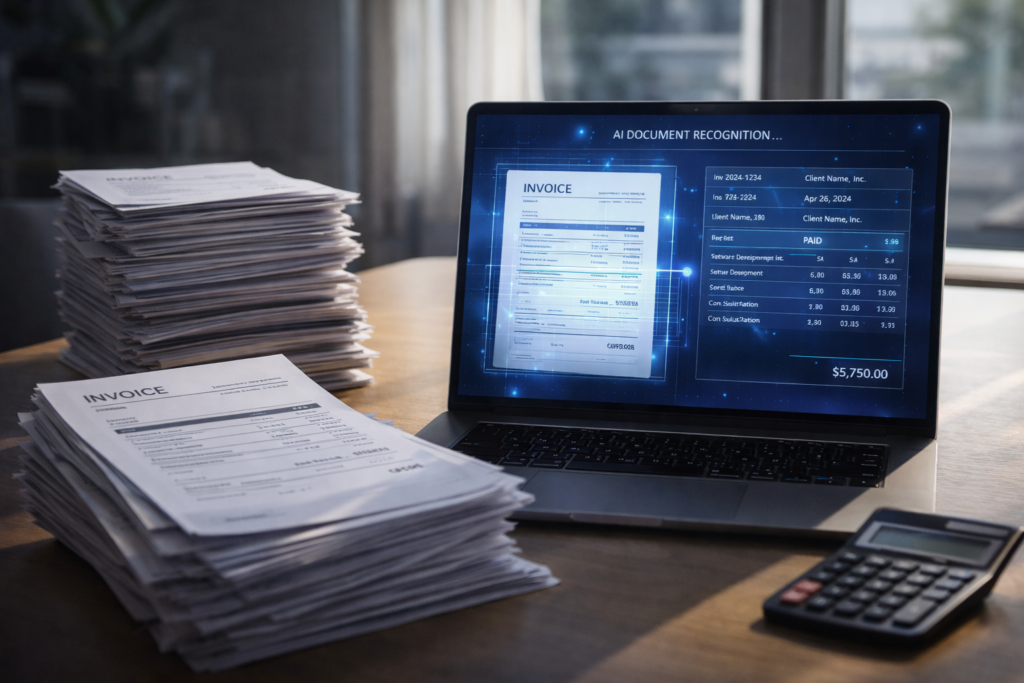
The AI automation workflow example here: incoming invoices (PDF or email) are processed by an AI document extraction tool (Docsumo, Rossum, or Nanonets). Key fields — vendor, amount, date, line items — are extracted automatically and pushed into your accounting software (Xero, QuickBooks, FreshBooks) with categories pre-assigned based on vendor history and line item descriptions.
Your job becomes reviewing exceptions, not processing everything. For freelancers and small business owners, this AI automation workflow example often pays for itself within the first month.
Workflow 7: Content Repurposing Engine
This AI automation workflow example turns every piece of long-form content into a full week of multi-channel distribution.
Time saved: 2–3 hours per content piece
Most professionals create content once and use it once. That’s a missed opportunity that the right AI automation workflow examples can solve permanently. That’s one of the biggest efficiency losses in modern marketing. A single 2,000-word article contains enough material for a newsletter, three social posts, a short video script, a slide deck outline, and a podcast talking points document.
The AI automation workflow example: when a blog post is published or added to a shared drive folder, an AI automation generates all derivative formats simultaneously. Each output is tailored to its destination format — the newsletter version reads conversationally, the LinkedIn post leads with a hook, the slide deck outline is structured as a narrative arc.
This is the AI automation workflow example that content teams most consistently say “I can’t believe I used to do this manually.”

Workflow 8: Competitor and Market Intelligence Digest
This AI automation workflow example solves a problem almost every professional faces: staying informed without spending hours doing it.
Time saved: 1.5–2 hours weekly
Staying informed about competitors, industry news, and market signals is genuinely important — and AI automation workflow examples for intelligence gathering are solving this problem elegantly in 2026. Most professionals do it badly — either spending too much time manually browsing, or not doing it at all and operating on outdated assumptions.
The AI automation workflow example: set up AI-powered monitoring (using tools like Perplexity API, Feedly + AI summarisation, or a custom Make scenario) to track competitor websites, industry publications, and keyword mentions across the web. Every Monday morning, an AI-generated intelligence digest lands in your inbox — competitor updates, industry news, trending topics, and a three-sentence “so what” summary for each item.
You stay informed in 10 minutes instead of 90. It’s a quiet but powerful AI automation workflow example that compounds in value every single week.

Workflow 9: Personalised Outreach at Scale
This AI automation workflow example closes the gap between personalisation quality and outreach volume.
Time saved: 3–4 hours weekly for business development
Cold outreach that actually works requires personalisation. But genuine personalisation at scale used to require an impossible trade-off between volume and quality.
AI automation workflow examples in outreach have changed that equation entirely. The AI automation workflow example: upload a list of prospects with LinkedIn profiles or company URLs. An AI agent researches each contact, identifies a relevant personalisation hook (recent company news, shared connection, published content), and drafts a tailored first-touch message for each. Your job is to review the batch, make any tone adjustments, and approve.
The quality of personalisation is genuinely impressive — and this AI automation workflow example is one of the most copied in B2B sales circles in 2026. — and the volume is impossible to replicate manually.

Workflow 10: Weekly Performance Reporting
This AI automation workflow example is one of the most consistently underestimated time-savers across all business functions.
Time saved: 2 hours weekly
Assembling weekly performance reports is one of those tasks that feels important while you’re doing it, but is almost entirely mechanical. You’re pulling numbers from five different platforms, formatting them consistently, writing the same contextual commentary in slightly different words, and sending the same deck structure to the same distribution list.
The AI automation workflow example: connect your analytics platforms (Google Analytics, HubSpot, LinkedIn Analytics, whatever your stack includes) via a reporting aggregator. An AI layer generates a formatted performance narrative — including variance analysis, highlights, and recommended actions — based on the raw numbers. The report compiles and distributes automatically at your chosen time every week.
You review the output, adjust the narrative if anything needs context — and you never spend two hours on reporting again. That is the promise of every great AI automation workflow example., and your Monday morning is no longer consumed by manual reporting.

Quick Reference: All 10 AI Automation Workflows at a Glance
The table below summarises all 10 AI automation workflow examples with their estimated time savings:
| Workflow | Time Saved / Week | Primary Tool Category |
|---|---|---|
| Email triage and draft replies | 5–7 hrs | Email AI + Zapier |
| Meeting notes to action items | 2–3 hrs | Transcription + AI summary |
| Social media content pipeline | 3–4 hrs | AI writing + scheduler |
| Lead research and CRM enrichment | 2–3 hrs | AI research agent + CRM |
| Support ticket routing | 4–5 hrs | AI classification + helpdesk |
| Invoice processing | 1–2 hrs | AI document extraction |
| Content repurposing engine | 2–3 hrs | AI writing + Drive |
| Market intelligence digest | 1.5–2 hrs | AI monitoring + email |
| Personalised outreach at scale | 3–4 hrs | AI personalisation + CRM |
| Weekly performance reporting | 2 hrs | Analytics + AI narrative |
Total potential time saved: 26–38 hours per week across a full team deployment.
Common Mistakes Professionals Make With AI Automation Workflows
This section might be the most valuable part of the entire article. Getting AI automation workflow examples wrong wastes more time than doing tasks manually.
Here are the most common mistakes people make when building AI automation workflow examples — and how to avoid them:
- Automating a broken process. AI automation makes fast what already exists. If your email workflow is chaotic, automating it makes chaotic things happen faster. Fix the process first, then automate it.
- Skipping the review layer. Every AI automation workflow example needs a human checkpoint — especially for anything client-facing. Remove the review step and you’re one bad AI output away from a reputation problem.
- Trying to automate everything at once. Pick one AI automation workflow example. Get it running properly. Measure the time saved. Then add the next. Teams that launch five automations simultaneously rarely succeed with any of them.
- Using the wrong trigger logic. The trigger — the event that starts your automation — is the most important part of the design. A poorly defined trigger fires the automation at the wrong time, on the wrong content, with the wrong results.
- Neglecting maintenance. AI workflows break when the tools they connect to update their APIs, change their interfaces, or alter their data structure. Build in a monthly 15-minute review of active workflows to catch issues before they become problems.
How to Build Your First AI Automation Workflow Example: Step-by-Step
If you’ve never built an AI automation workflow example before, here’s the fastest path from zero to a working workflow:
- Choose your highest-pain manual task — pick the one repetitive task that costs you the most time and least satisfaction each week
- Map the trigger and outcome — define exactly what event starts the workflow and what the finished output looks like
- Choose your automation platform — Zapier for simplicity, Make for power, n8n for full control and self-hosting
- Connect your AI layer — most platforms have native integrations with OpenAI, Claude API, or Gemini for the intelligence step
- Build a minimum viable workflow — start with the simplest version that delivers value; add complexity only after the basics run reliably
- Run it in test mode for one week — review every output manually before trusting the automation to run unsupervised
- Measure the time saved — document the before and after; this builds the internal business case for expanding automation further
Frequently Asked Questions About AI Automation Workflow Examples
Q1: What are AI automation workflow examples in simple terms? An AI automation workflow example is a pre-built, repeatable process where AI handles specific tasks automatically — like sorting emails, generating reports, or drafting responses — triggered by defined events and requiring minimal human input once set up. The AI replaces manual, repetitive decision-making steps that previously consumed professional time.
Q2: Do I need coding skills to build AI automation workflows? No. Platforms like Zapier, Make, and n8n offer no-code and low-code interfaces that let professionals build sophisticated multi-step AI workflows without writing code. More complex custom workflows may benefit from basic scripting knowledge, but the vast majority of the workflows in this article can be built entirely through drag-and-drop interfaces.
Q3: Which tools work best for AI automation workflow examples and AI productivity workflows in 2026? The most widely used combination is: Make or Zapier for workflow orchestration, Claude API or OpenAI GPT-4 for the AI intelligence layer, and native integrations with Gmail, Slack, HubSpot, Notion, and Google Workspace for the input and output ends. The right stack depends on your existing tools and technical comfort level.
Q4: How long does it take to build an AI automation workflow example? Simple workflows — like auto-categorising emails or generating social posts from a blog — take 30–90 minutes to set up for the first time. More complex workflows involving multiple tools, conditional logic, or custom AI prompting can take 3–5 hours. Most professionals recoup that setup time within the first two weeks of the automation running.
Q5: Are AI automation workflows safe to use for sensitive business data? This depends entirely on which tools you use and how you configure them. Enterprise plans for tools like Zapier, Make, and major AI API providers include data processing agreements (DPAs) and comply with GDPR and SOC 2 standards. For highly sensitive data — legal, financial, healthcare — review each tool’s data retention and processing policies before connecting them to automated workflows.
Final Thoughts: Your 5+ Hours Start This Week
Let’s close with the three things that matter most from everything above.
First, the time savings from AI automation workflow examples are real and measurable — but only if you build workflows for genuine pain points, not impressive-sounding use cases that don’t reflect your actual workday. Second, start with one AI automation workflow example, run it properly, and prove the value before scaling. The professionals seeing the biggest gains aren’t the ones with the most automations — they’re the ones with the most reliable automations. Third, AI productivity workflows are most powerful when they free your attention for the work only you can do — strategy, relationships, creativity, and judgement. Let the machines handle the mechanics.
You now have 10 specific, deployable AI automation workflow examples. Each AI automation workflow example on this list has been validated in real professional environments — and a clear framework for building more as your confidence grows.
You now have 10 specific, deployable AI automation workflow examples that other professionals are using today to recover 5, 10, even 20 hours a week.
Right now — today — open Make or Zapier, sign up for a free account, and map out the trigger and outcome for Workflow 1 (email triage). You don’t need to build the whole AI automation workflow example today. Just map it. The momentum you build from completing your first AI automation workflow example in that one hour will carry you further than any amount of reading about automation.
In our next article, we’ll show you how to build a complete no-code AI automation system from scratch — including the exact prompt structures, tool configurations, and testing protocols that separate automations that run flawlessly from those that quietly break on a Tuesday afternoon.